Restaurant stock management: complete guide 2026 (FIFO, stocktake, food waste)
Stock management: FIFO/FEFO method, stocktake frequency, costing, food waste. Software vs spreadsheet.
In short. Restaurant stock management looks simple on paper: what comes in, what goes out, what's left. In practice, that's exactly where 15% of your perishable purchases hit the bin without you noticing. FIFO, FEFO, weekly stocktake, latest-purchase costing — this guide gives you the full method to run your stock in 2026, without burning your life on it.
Context / Definition
Restaurant stock management covers all the processes used to track inflows, outflows and stock levels in a foodservice operation — from raw ingredients to prepped items — to control food cost, cut waste and keep regulatory traceability.
Restaurant stock management: a tracking method for inflows and outflows that gives you, in real time, the value of your stock, your real food cost and your food waste — so you can decide fast, and right.
A poorly managed stock is cash you can't see. It's a fridge full of money burning quietly. It's a menu item running out at 7:30pm on a Friday night. It's not a discipline or motivation problem — it's a method and tool problem.
Why stock management is directly tied to your food cost
Food cost is the ratio of what you buy to what you sell. But that ratio doesn't lie: if you don't know what's in stock today, you can't compute your real food cost. You're running blind.
A restaurant with no food cost control often discovers at the annual close that it runs at 36 or 38% when it thought it was at 30%. Those 6 to 8 points of drift are the difference between paying yourself and not. I lived that at La Verrerie. I saw it again with food truckers reaching out after the fact, lost in front of their first set of accounts.
Stock is the missing link. You can have the best recipe cards in the world — if you don't know what's left in the cold room, those cards mean nothing for working out what you actually consumed.
To go further on the stock / food cost link, read stock impact on food cost.
The three levers of stock
Well-managed stock pulls three levers at once:
- Real food cost — you know what you consume, not what you order
- Food waste — you spot the leaks (overstock, expired stock, internal theft)
- HACCP traceability — you know where each product comes from, when it came in, when it has to go out
Those three levers are interdependent. You can't work one without the other two.
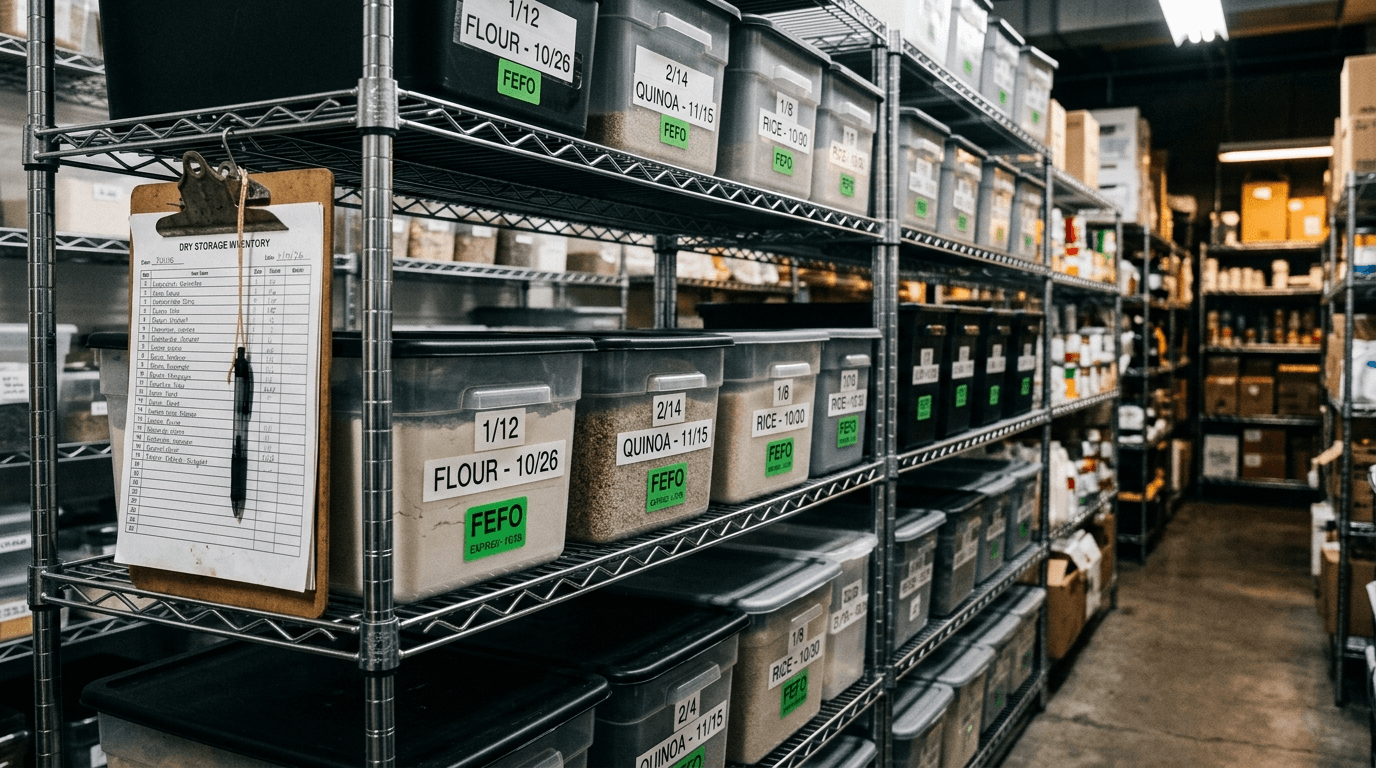
FIFO or FEFO: which method for your restaurant?
That's the first question I ask any chef who starts working with me. The answer depends on what you store.
FIFO stands for First In, First Out: the first item into stock is the first one out. Classic rotation, valid for anything with a long shelf life or a stable, predictable use-by date — canned goods, dry stock, bottled drinks.
FEFO stands for First Expired, First Out: the item with the closest expiry date goes out first, regardless of when it came in. That's the rule for everything perishable — meat, fish, dairy, eggs, fresh produce.
In the kitchen, FEFO should be physically visible: products with the shortest use-by date ALWAYS sit at the front, within reach. I call it "the fridge front line" — what's in front is what goes out tonight.
FIFO vs FEFO: comparison table
| Criterion | FIFO | FEFO |
|---|---|---|
| Principle | First in, first out | First expiry, first out |
| Main use | Dry goods, drinks, canned | Fresh, perishable, frozen |
| Risk if ignored | Slow rotation, forgotten stock | Expired stock, food safety risk |
| Regulatory requirement | No (good practice) | Yes — EC reg. 852/2004, HACCP |
| Implementation effort | Low | Medium (visible date labels) |
The link between FEFO and your regulatory traceability is direct. For everything tied to those obligations, see our stock and HACCP: traceability guide.
How often should you stocktake?
Monthly. That's what everyone does. It's also the legal minimum to keep your books straight.
But monthly, for food cost control, is not enough. Here's why.
A monthly stocktake tells you what you consumed over 30 days. Too late to fix drift. If your food cost shoots to 38% in week 2, you only see it in week 5 or 6. In between, you've kept bleeding cash quietly.
A weekly stocktake gives you the real food cost of the week just gone. You spot drift. You correct. That's real control.
I cover the full frequency logic and what it actually changes in stocktake and optimal frequency.
How to run a 20-minute weekly stocktake
The key is method. Not willpower.
- Categorise once and for all — meat, fish, dairy, veg, dry, drinks, frozen. That split doesn't change.
- Lock in a fixed slot — Monday morning before service, or Sunday night after close. Always the same moment.
- Count in order — one zone at a time, no skipping. Walk-in fridge → freezer → dry → bar.
- Enter direct on the tool — paper plus spreadsheet entry is the work twice. A mobile tool does it in one pass.
- Compare automatically — theoretical stock (last stock + purchases - sales) vs actual count. The variance is your food waste.
The gap between 4 hours and 20 minutes isn't the number of products. It's method and tool.
Case study — La Verrerie 2016, then Lunch Wagon 2024
In 2016, at La Verrerie in Gaillac, I did stocktake once a month. Half a day blocked: two people, paper, pen, mental maths or a spreadsheet. Four hours minimum. And at the end you had one global stock figure — no view by category, no comparison with theoretical, no flag on variances.
The problem: those 4 hours were for the books. Not for control. By the time I looked at the numbers, 30 days of consumption had already gone past. And the losses I could have caught in week 2? Invisible. Drowned in the month.
I figured my food waste was 4 to 5% of food cost — average for a working bistro, but not actively controlled.
At the Lunch Wagon in Albi, in 2024, I changed method. Stocktake every Monday morning, before the first service of the week. 20 minutes. Stock up to date. Last week's food cost calculated right after.
What it changed: you see the problem in the week it happens. A supplier shorted you 2 kg vs the invoice? Visible. A rush week where you burnt 8% more on steaks than planned? Visible. You correct the next order before the problem stacks up.
On a food truck with a tight range — about fifty active SKUs — a 20-minute weekly stocktake was doable solo. And it kept my food cost around 28-30% across the three years, despite the 2024 spikes on beef.
To see how orders flowed straight from that weekly stocktake, read automate orders from stock.
How to cost your stock
Stock costing answers a simple question: how much is what's in your fridges and stores worth today?
There are two main methods.
Comparison table: latest purchase price vs WAC
| Method | Principle | Strength | Limit |
|---|---|---|---|
| Latest purchase price | Quantity × last invoiced supplier price | Simple, fast, matches your price list | Can overvalue if you bought high once |
| WAC (Weighted-Average Cost) | Weighted average of all purchase prices in period | More precise on volatile prices | More complex maths, needs automation |
| Standard price | Fixed price set at start of period | Stable for comparison | Drifts from reality if inflation runs hard |
For an independent running solo, latest purchase price is the most workable method. That's what I used at the Lunch Wagon. Take the last invoice for each line, multiply by counted quantity. Done.
WAC is more rigorous — that's what stock software calculates automatically. If your tool does it for you, use it. If you're doing this by hand on a spreadsheet, latest purchase price gives you a result that's good enough to steer.
On products with strong price swings — meat, fish, oil — always use the latest delivery price for costing. A 10% move on minced beef shifts your stock value materially if you've got 30 kg in the walk-in.
Stock management: paper, spreadsheet or dedicated software?
The real question isn't "spreadsheet or software". The real question is: does your tool recalculate automatically when a price moves?
- Cost
- Zero
- Mobile stocktake
- No
- Auto food cost
- No
- Out-of-stock alert
- No
- Inspector traceability
- Photocopies
- Cost
- £0 to £15/month
- Mobile stocktake
- Hard
- Auto food cost
- If formulas hold
- Out-of-stock alert
- No
- Inspector traceability
- Manual PDF export
- Cost
- £49 to £149/month
- Mobile stocktake
- PWA in the walk-in
- Auto food cost
- Auto cascade
- Out-of-stock alert
- Real time
- Inspector traceability
- Built-in PDF export
The real win with dedicated software isn't the data entry — it's the cascade. When your supplier raises butter by 12%, every recipe card containing butter has its food cost recalculated in real time. On a spreadsheet, you spend 45 minutes updating everything by hand. And you forget one card.
To compare what's available in 2026, see restaurant stock software 2026.
Common stock management mistakes
The most expensive mistake: ordering with no prior stocktake. You order "by gut", you overorder, you bin. On a bistro with 3 to 5% uncontrolled food waste, that's £4,750 a year wasted on £95k of purchases — before you've even tried to optimise.
-
Doing the monthly stocktake just for the books, never using it for control. Result: you know your numbers too late to act.
-
Overstocking on perishables. 15% overstock on fresh = 15% headed to the bin. Smaller, more frequent orders beat one big weekly order on products that hold for 3 days.
-
Not labelling use-by dates on receipt. Without a visible entry date, FEFO becomes impossible. And someone ends up grabbing the carton at the back without seeing the front one expires tomorrow.
-
Costing your stock at sell price instead of purchase price. Classic error that inflates value and skews your food cost ratio.
-
Forgetting yield losses in the maths. A 2.5 kg leg of lamb yields 1.8 kg of usable meat. If you ignore that yield ratio in your cards, your real food cost is undervalued.
To systematically spot and reduce waste, read food waste: identify and reduce.
Conclusion
Three things to keep on restaurant stock management in 2026:
1. Stock is locked-up cash — not an accounting line. 15% perishable overstock plus 3 to 5% uncontrolled waste is money burning every week, silently. Step one is making it visible.
2. Method beats frequency. A clean monthly stocktake beats a botched weekly one. But a 20-minute weekly stocktake on the right tool is what lets you fix drift in the week it happens — not 30 days later.
3. FIFO and FEFO aren't training-room acronyms — they're physical storage rules. What's in front goes out first. What expires soonest goes out first. That's it. Applied strictly, those two rules cut waste and protect against food safety risk.
Well-run stock is the base everything else stands on: reliable food cost, right-sized orders, solid HACCP traceability. It's not management for the sake of management. It's running your restaurant instead of being run by it.
Si t'as aimé cet article, lis celui-ci ensuite :
→ Best restaurant software 2026: the complete comparison (top 10)↗Articles liés
Restaurant stocktake: how often and how (2026)
Restaurant stocktake: optimal frequency, fast method, costing, tools. From 4-hour monthly to 20-minute weekly.
Best restaurant software 2026: the complete comparison (top 10)
2026 comparison of restaurant management software: food cost, recipe cards, HACCP, stock, ordering. Selection criteria + comparison table.
Restaurant food waste: identify and reduce in 2026
Food waste: typology (breakage, expiry, over-portioning, theft), measurement method, reduction levers.
Restaurant purchase order: free template + WhatsApp dispatch (2026)
Restaurant purchase order template PDF + Excel. WhatsApp and email dispatch method, legal format.
Last updated 2026. Written by Cyril Quesnel, founder of Onrush, chef-entrepreneur (La Verrerie 2015-2018, Lunch Wagon 2023-2026).