Restaurant profitability: the complete 2026 guide (ratios, KPIs, daily control)
Restaurant profitability: target ratios, food cost + labour, break-even, daily KPIs. Field-tested method across 2 venues.
The short version. Restaurant profitability runs on 3 ratios: food cost (target 28-32%), labour (target 30-35%) and EBITDA (target 8-12%). Those first two line items eat 60-65% of revenue before you've even paid rent. If you discover your margins on the year-end P&L, it's already too late. This guide shows you how to run those numbers daily.
Context / Definition
Restaurant profitability is the venue's ability to generate real profit after covering every cost: ingredients, wages, rent, utilities, insurance, tax. It's not revenue. It's not "what's in the till on Saturday night" either. It's a structured machine, with precise ratios, and you run it week after week — not once a year when your accountant hands you the P&L.
Restaurant profitability: a venue's ability to generate positive EBITDA after deducting operating costs — food cost, labour, fixed costs — expressed as a percentage of net revenue.
Most chefs I've worked with know their menu inside out. Their recipe cards, much less. Their live ratios, almost none. That's where the trouble starts.
What's the average restaurant profitability?
The short answer: 8 to 12% EBITDA for a well-run classic bistro. That's the target. Not the average sector reality — which usually sits well below.
Here's how the ratios break down by venue type in 2026:
| Venue type | Target EBITDA | Typical food cost | Labour ratio |
|---|---|---|---|
| Classic bistro / brasserie | 8–12% | 28–32% | 30–35% |
| Fine dining | 5–8% | 30–38% | 38–45% |
| Fast-casual / efficient model | 15–20% | 25–30% | 25–30% |
| Well-positioned food truck | 18–25% | 28–33% | 20–28% |
| Quick service | 12–18% | 25–30% | 28–32% |
These numbers are targets, not guarantees. They assume active control, a properly sized menu, and a location that delivers enough volume to absorb fixed costs.
What jumps out is the gap between fine dining and fast-casual. The more skilled labour you carry, the more your labour ratio explodes — and the tighter net margin gets. Pure maths.
The €1 million revenue trap
I turned around La Verrerie in Gaillac between 2015 and 2018. We grew from €300k to €1 million revenue in three years. When I sold, I finally understood something I should have grasped much earlier: revenue does not equal profit.
Once I added back the fully-loaded wages I'd skipped paying myself for 3 years, the actual cash-out was way thinner than revenue suggested. This isn't an anecdote — it's a structural lesson on restaurant profitability you don't pick up in culinary school.
The key ratios to track in a restaurant
Five ratios deserve your attention as priorities. Not twenty. Five.
1. Food cost (cost of goods)
The ratio between what you buy to cook and what you take in. Target: 28 to 32% in a bistro. Past 33%, you've got a problem — either in your purchasing, your recipe cards and plate cost, or your waste.
For the full method on calculating and reading food cost, the real, fully-loaded food cost guide covers everything.
2. The labour ratio
Gross wages + employer charges divided by net revenue. Target: 30 to 35% for a bistro. Below 28% you're probably understaffed or underpaying yourself. Above 38% you're losing money on operations.
3. Prime cost
Food cost + labour ratio. In a classic bistro, target is 60 to 65% of revenue. Beyond that, there's not enough left to cover rent, utilities, insurance and still pull a margin.
Prime cost: food cost + labour ratio, expressed as a % of net revenue. It's the survival ratio of a restaurant. If your prime cost exceeds 65%, you're working for free.
4. EBITDA
What's left after every operating cost is paid, before tax and depreciation. The real measure of your venue's health. Target: 8 to 12% in a bistro, 5 to 8% in fine dining.
5. Average check and table turnover
Not strictly profitability ratios, but they drive your top line. A €28 average check with 2 turns per service does not produce the same result as €22 with 2.5 turns. The menu engineering and menu profitability guide explains how to work both levers at once.
Before touching anything on your menu, calculate your current prime cost. That number tells you whether the issue lives in purchasing, labour, or pricing structure. Acting without that diagnosis is operating blind.
How to calculate a restaurant's break-even point
The break-even point is the revenue level at which you cover all fixed and variable costs without losing money. Below it, you lose. Above it, you start earning.
Base formula:
Break-even = Fixed costs / (1 − [Variable costs / Revenue])
In practice, here's how to apply it:
-
List your monthly fixed costs — rent, insurance, subscriptions, salaried wages, loan repayments. The costs you pay whether the room is full or empty.
-
Calculate your contribution margin rate — that's 1 minus your cost-of-goods and variable-labour ratio.
-
Divide fixed costs by that rate — you get the minimum monthly revenue not to lose money.
Concrete example: €15,000 fixed costs per month, contribution margin rate of 40%. Break-even = 15,000 / 0.40 = €37,500 minimum monthly revenue.
If you do €35,000 that month, you lose €1,000. If you do €42,000, you make €1,800 before tax.
Run this calculation once at opening, then revisit every quarter — fixed costs move (lease renegotiation, new loan, full-time hire).
How to run profitability daily
This is where most chefs fall down. Not from lack of intelligence — lack of tool and method.
Here's the rhythm I use:
-
Every night: log the day's revenue (cash-out)
-
Every week: calculate weekly food cost — purchases received divided by weekly revenue. If you cross 33%, you spot the issue immediately (supplier, waste, over-prep)
-
Every week: check the labour ratio — scheduled hours x fully-loaded hourly cost, divided by weekly revenue
-
Every month: estimate provisional EBITDA — revenue minus prime cost minus fixed costs. That's your monthly snapshot, not the year-end P&L.
-
Every quarter: revisit break-even and adjust revenue targets
The key? Don't wait for the year-end P&L. When your accountant pulls last year's numbers in March, all 12 months are locked. You can't fix anything. Real-time control is the only antidote.
To go further on building an operational dashboard, the KPIs and dashboard guide details every indicator and how to automate it.
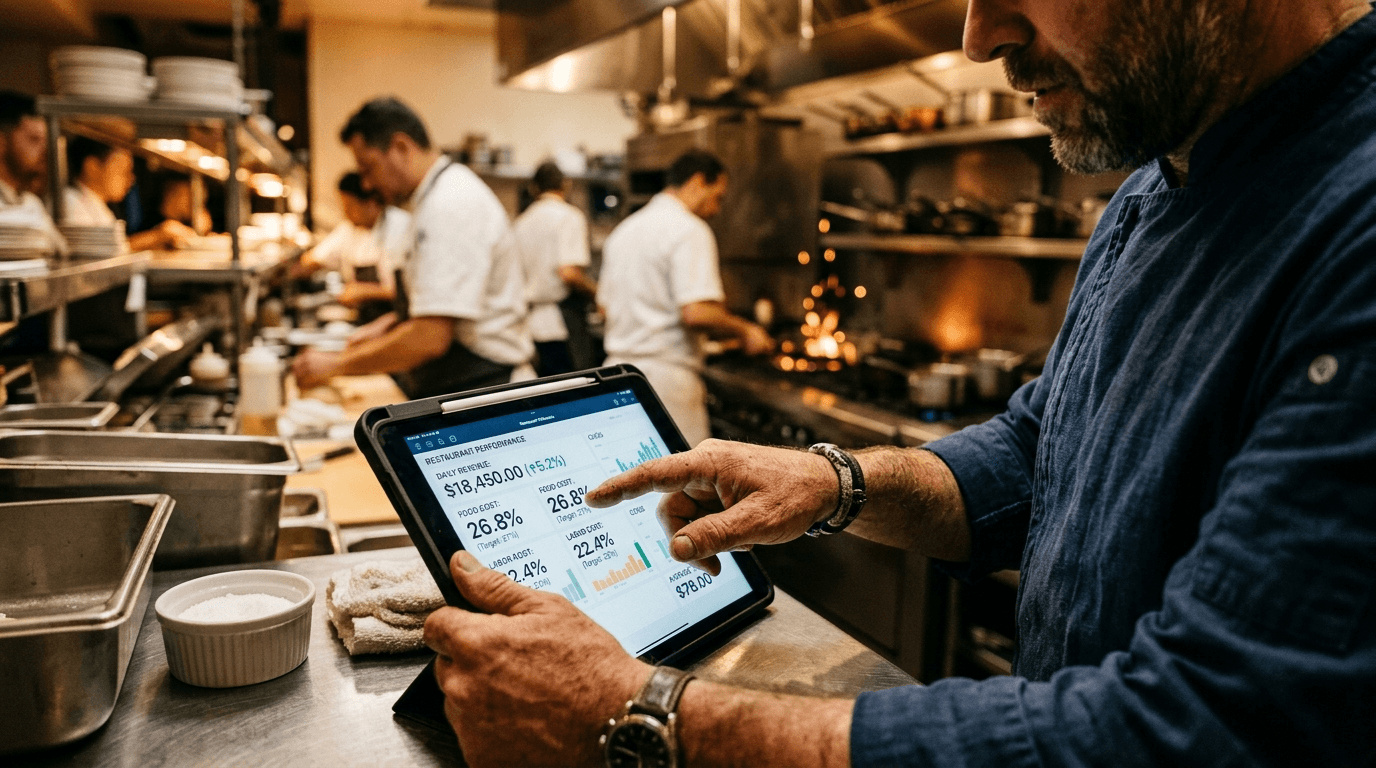
Past 30 covers a day, manual Excel tracking becomes unmanageable. Errors stack up, time slips, precision drops. That's the threshold where management software earns its place — not as a luxury, as an investment.
Case study — La Verrerie, Gaillac (2015-2018)
In September 2015 I took over La Verrerie — a hotel-restaurant with bistronomic cuisine, 14 rooms and a spa, in Gaillac (south-west France). Acquired out of administration. The previous operator had been turning over €300,000. The business was bleeding money.
First thing I did: a full review of margins, menu, purchasing, schedules. No gut feel. Numbers.
Initial diagnosis was brutal: EBITDA at 3%. On €300,000 revenue, roughly €9,000 left over before tax and depreciation. The kind of number that explains why the previous operator was insolvent. You can have a packed dining room on weekends and still lose money if the ratios aren't held.
Work started with recipe cards — every single one redone and costed. Then the supplier price book: I knew this side well, I'd spent two years at a major French foodservice distributor as a B2B sales rep around Paris. I knew how to negotiate annual contracts, how to read year-end rebates, how to compare supplier pricing without getting fooled.
Then the schedules: cutting variable labour outside service peaks, without touching full-time staff or sacrificing service quality.
By 2017, two years after takeover, EBITDA was at 11%. On revenue that had crossed €600,000 by then. No miracle — the result of 24 months of weekly ratio tracking.
What I wish I'd had at the time: a tool that auto-calculated food cost the moment a supplier invoice landed, no manual re-entry. It would have saved me hours every week and avoided rushed maths errors under service pressure.
For cutting your food cost, the levers I pulled at La Verrerie are documented in detail.
Comparison: manual vs automated control
The choice of tool changes the quality of information and the time you spend.
- Food cost update
- Weekly at best
- Entry errors
- Frequent under pressure
- Price cascade
- Manual, tedious
- Time per week
- 3 to 6 hours
- Mobile access
- No
- Monthly cost
- €0
- Food cost update
- Daily (D+0)
- Entry errors
- Near zero (OCR)
- Price cascade
- Auto across every recipe card
- Time per week
- 20 to 40 min
- Mobile access
- Yes, PWA
- Monthly cost
- €30 to €150
Below 20 covers a day, Excel can hold up if you're disciplined. Above that, manual entry time blows past software cost. And precision drops too.
To pick the right tool for your size and budget, the best restaurant management software 2026 guide compares the main solutions on the market.
Common mistakes
Confusing revenue with profitability: the most expensive mistake in restaurants. Rising revenue can mask deteriorating margins if food cost or labour drift at the same time. Always look at the ratios, never revenue alone.
Mistake #1 — Discovering your margins on the year-end P&L When your accountant hands you the numbers in March, all 12 months are already played out. The adjustments you could have made in April, May, or June of last year — you'll never make them now. Weekly control is the only way to correct in real time.
Mistake #2 — Not updating recipe cards when supplier prices move If your supplier raises beef by 8% in October and you don't recost your cards, your food cost drifts without you noticing. Three months later, you're wondering why margins dropped.
Mistake #3 — Calculating food cost on purchases, not actual sales Theoretical food cost (from recipe cards) and actual food cost (purchases vs revenue) need to be compared. A gap above 3 points signals waste, theft, or a recipe error.
Mistake #4 — Underestimating labour ratio on slow days A Saturday lunch at 80 covers, your labour ratio is fine. A Tuesday lunch at 18 covers with the same crew, it explodes. Scheduling to forecast volume, not habit, is a direct profitability lever.
Mistake #5 — Not paying yourself, or underpaying yourself If you don't include your own fully-loaded salary in your costs, your ratios are wrong. And on resale, a venue where the owner doesn't pay themselves is valued less than one where pay is fully booked. I learned this at La Verrerie.
Conclusion
Three takeaways from this guide:
1. Prime cost is your survival indicator. Food cost + labour = 60 to 65% of revenue in a classic bistro. If you cross that, the rest of your cost structure can't be covered by what's left. First ratio to calculate, before anything else.
2. The year-end P&L is too late. Margins are run week by week. A food cost drifting 3 points in October means thousands of euros lost by December. Only real-time control lets you correct before damage is done.
3. Structure precedes growth. Before raising prices, changing the menu, or expanding the dining room, understand your current ratios. I spent 24 months at La Verrerie on recipe cards, schedules and supplier pricing before revenue took off. That's the order it works in.
If you want to see how these ratios can be tracked automatically — day-zero food cost, labour ratio, supplier price cascade across every recipe card — that's exactly what Onrush does.
Si t'as aimé cet article, lis celui-ci ensuite :
→ Best restaurant software 2026: the complete comparison (top 10)↗Articles liés
Restaurant menu engineering: optimising your menu profitability (2026)
Menu engineering: popularity × margin matrix, stars vs dogs, repositioning method. Add 3 to 7% revenue.
Restaurant KPIs: the essential 2026 dashboard (12 indicators)
The 12 KPIs to track in a restaurant: food cost, labour ratio, average check, revenue per sqm. Sample dashboard + frequency.
Best restaurant software 2026: the complete comparison (top 10)
2026 comparison of restaurant management software: food cost, recipe cards, HACCP, stock, ordering. Selection criteria + comparison table.
Food cost: how to calculate it precisely (formula + worked example)
Theoretical food cost formula, actual food cost, food cost per dish. Worked numbers + free worksheet.
Last updated 2026. Written by Cyril Quesnel, founder of Onrush, chef-entrepreneur (La Verrerie 2015-2018, Lunch Wagon 2023-2026).