Restaurant KPIs: the essential 2026 dashboard (12 indicators)
The 12 KPIs to track in a restaurant: food cost, labour ratio, average check, revenue per sqm. Sample dashboard + frequency.
The short version. A restaurant KPI is a number that tells you the business is drifting — before the bank does. The 12 essential indicators cover food cost, labour ratio, prime cost, average check, turnover, dish-level profitability and customer satisfaction. 5 minutes every morning is enough. As long as they all live in one place.
Context / Definition
A restaurant dashboard isn't an accounting report. It's your daily cockpit. The numbers that let you decide — change an order, drop a menu line, tighten a schedule — before damage is done. Most operators I've worked with run on instinct. They discover their margins on the year-end P&L. By then it's too late to fix anything.
Restaurant KPI: a key performance indicator that lets you measure financial and operational health in real time, distinct from accounting data which only shows up after the fact.
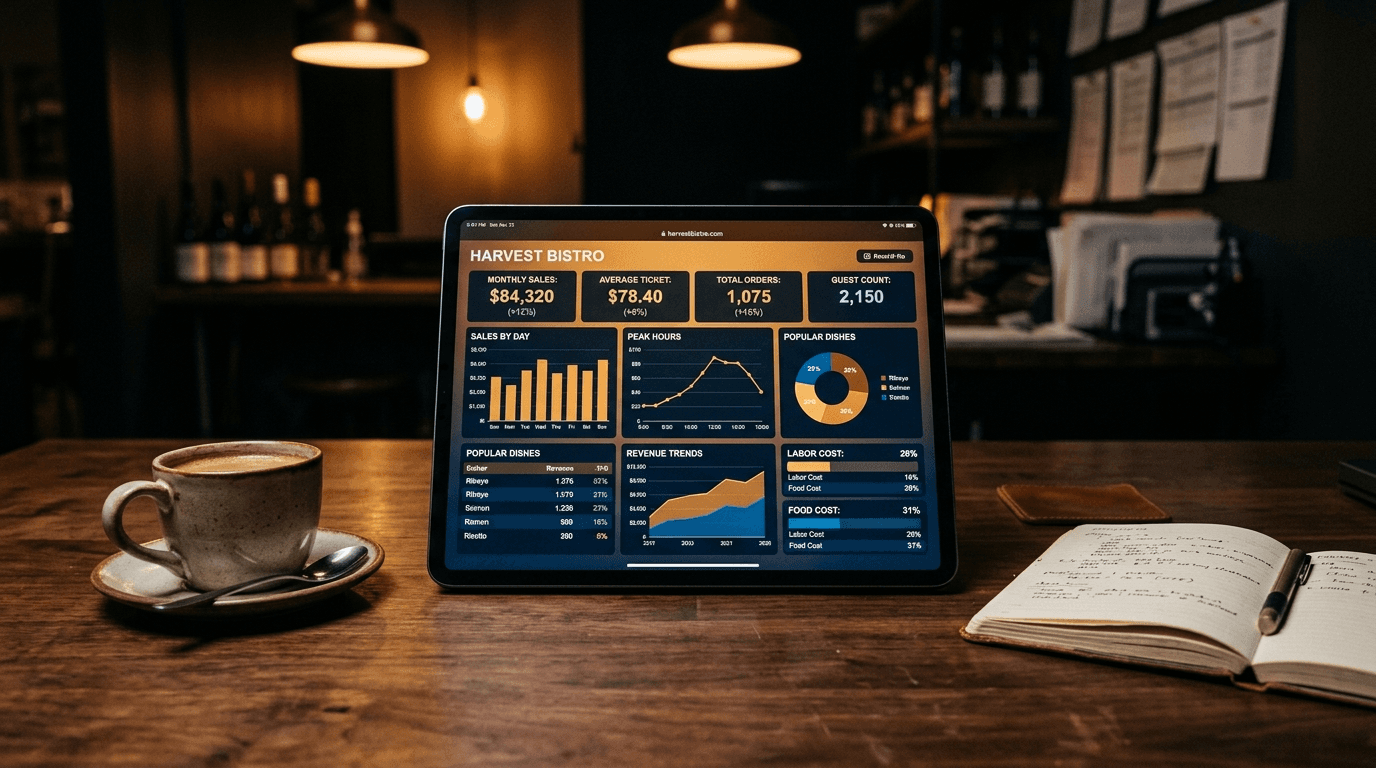
What are the 12 essential KPIs of a restaurant?
Restaurant indicators fall into four families. Each answers a different question. Together they give you a complete view — without drowning you in noise.
To understand how these ratios connect to your overall profitability and ratios, start with the foundation. Here, we go straight to the point: 12 numbers, their role, their frequency.
Family 1 — Food and beverage costs
1. Food cost ratio: cost of goods consumed divided by matching net revenue. Standard: 28-35% in kitchen, up to 20% on drinks. Past 35%, you're feeding the bank more than yourself. To build this ratio properly, daily food cost gives you the full method.
2. Dish-level profitability: gross margin generated by each menu item. A dish that sells well but costs a lot drains you silently. That's the focus of menu engineering for a profitable menu — the discipline of not keeping the bad students on your menu.
3. Food waste: gap between what you ordered and what you sold or used in recipes. A waste rate above 4-5% over a week signals a problem — receiving, storage, recipe cards not being followed.
Family 2 — Labour costs
4. Labour ratio: fully-loaded payroll divided by net revenue. Standard: 30-35% in casual dining, up to 40% in hotel-restaurant operations with rooms. Above 38% over a month, look hard at your schedules.
5. Prime cost: food cost + labour ratio. The king ratio. It represents the margin available before every other fixed cost. A prime cost under 65% gives you breathing room. Above 70%, the model is structurally stressed.
Family 3 — Sales performance
6. Cumulative revenue: today's revenue vs the same day last year, and vs your monthly target. A daily leadership KPI. You know in 10 seconds whether you're behind or ahead.
7. Average ticket: revenue divided by number of tickets. Measures spend per transaction. Watch it by service (lunch vs dinner, weekday vs weekend) — gaps are usually telling.
8. Revenue per cover: revenue divided by number of covers. Different from the ticket if a table orders for two. Useful to measure the efficiency of your dining room and add-on sales by your team.
9. Table turnover rate: how many times a table turns over during a service. In a city bistro, aim for 2.5-3 turns at lunch. Bistronomy: 1.5-2. A low turn on a service that "felt busy" signals a flow problem in the dining room or kitchen.
Family 4 — Resource management
10. Dormant stock: items ordered but unused for over 15 days. Every euro asleep in stock is a euro not turning. Real-time stock management breaks down how to track these leaks.
11. Customer satisfaction rate: Google rating, direct feedback, surveys. Not strictly a financial KPI — but an early-warning signal for revenue creation or destruction in the next 3 months. A restaurant slipping from 4.4 to 4.1 on Google loses covers before it ever shows up in the till.
12. Revenue per square metre: monthly revenue divided by usable surface area. Lets you compare the efficiency of different setups (terrace vs dining room, bar vs tables). Useful if you're considering expanding or reducing space.
How do I structure reading my restaurant indicators?
Frequency matters as much as the numbers themselves. A KPI looked at once a month is useless — that's an autopsy, not control.
- Daily: food cost, labour ratio, cumulative revenue. These three tell you whether the day was healthy or something's drifting.
- Weekly: food waste, table turnover, average ticket. A week is the basic operational unit in restaurants.
- Monthly: dish-level profitability, dormant stock, prime cost, revenue per square metre, customer satisfaction. These need distance to be read properly.
Don't put more than 3 daily KPIs on your morning screen. The goal is to decide in 5 minutes — not to do analysis. Save analysis for Sunday night or Monday morning, before service.
Case study — The Lunch Wagon morning dashboard
When I took over the Lunch Wagon in 2023 — a burger food truck in Albi, acquired out of administration, zero locations booked, zero quotes signed — I needed tight control without spending mornings buried in spreadsheets.
I built a restaurant dashboard with 12 lines. One page. Vertical read. 5 minutes before first service. Yesterday's food cost, this week's labour ratio, cumulative revenue vs monthly target, observed waste, next HACCP check. Nothing more.
What it concretely changed: zero service run blind. I knew arriving at the truck whether I had room for a lunch promo or had to tighten orders. Over 3 years, we went from nothing to €200,000 annual revenue, with event-catering quotes signed a year out. The daily structure is a meaningful part of that progression. Permanent improvisation is exhausting — and expensive.
Comparison — Spreadsheet dashboard vs centralised software
| Criterion | Excel / Sheets | Centralised software |
|---|---|---|
| Updates | Manual, often late | Automatic (POS + stock + payroll) |
| Error risk | High (double entry, version drift) | Low |
| Daily time | 20-45 min | 3-7 min |
| Data consistency | Fragile across multiple sources | Reliable (single source) |
| Cost | €0 (but hidden time cost) | €40-150/month depending on tool |
| Mobile usable | Difficult | Native mobile (PWA) |
| Best for | Startup, indicator testing | Operating venue |
For more on choosing full management software, the dedicated comparison details what really matters.
Common mistakes on restaurant KPIs
Looking at revenue alone is the most expensive mistake in restaurants. A venue can hit a record Saturday and still lose money that night — if food cost exploded on the special menu and labour was running on overtime. Revenue without the matching costs is vanity.
- Too many KPIs: past 12-15 indicators, you stop looking. You drown in data and decide on instinct anyway. Better 5 KPIs read carefully than 30 ignored.
- Wrong frequency: watching dormant stock daily adds nothing. Checking food cost monthly is an autopsy. Each indicator has its natural cadence — respect it.
- Out-of-sync sources: if your food cost lives in one Excel file, your labour ratio in another and your revenue in your POS, the three will never speak the same language. You'll spend your time reconciling instead of deciding.
- No time reference: a food cost at 32% means nothing without comparing it to last month, the same month last year, and your target. A number on its own isn't a KPI — it's just a number.
Conclusion
Three things to remember.
First: 12 KPIs are enough. Not 30, not 5. These 12 indicators cover every operational decision in an independent restaurant — from food costs to customer satisfaction.
Second: frequency makes the control. A food cost looked at once a month is a P&L read too late. Daily, weekly, monthly — every KPI has its rhythm. Respecting it is the move from reactive to proactive.
Third: a dashboard only works if the data lives in one place. Excel + POS + separate HR file is three different languages you have to translate every morning. The tool that centralises everything turns 45 minutes of reconciliation into 5 minutes of reading.
Numbers don't make profit. But without the right numbers at the right moment, you can't run the business. It's that simple.
Tu veux voir comment Onrush gère ça sur ton restaurant ?
Démo 20 min, sans engagement. On regarde tes vrais chiffres.
Demander une démo →Articles liés
Best restaurant software 2026: the complete comparison (top 10)
2026 comparison of restaurant management software: food cost, recipe cards, HACCP, stock, ordering. Selection criteria + comparison table.
Restaurant menu engineering: optimising your menu profitability (2026)
Menu engineering: popularity × margin matrix, stars vs dogs, repositioning method. Add 3 to 7% revenue.
Restaurant profitability: the complete 2026 guide (ratios, KPIs, daily control)
Restaurant profitability: target ratios, food cost + labour, break-even, daily KPIs. Field-tested method across 2 venues.
Best food cost software 2026: comparison + selection criteria
2026 comparison of restaurant food cost software: price cascade, theoretical/actual, POS integrations. Top 5 reviewed.
Last updated 2026. Written by Cyril Quesnel, founder of Onrush, chef-entrepreneur (La Verrerie 2015-2018, Lunch Wagon 2023-2026).