Restaurant stocktake: how often and how (2026)
Restaurant stocktake: optimal frequency, fast method, costing, tools. From 4-hour monthly to 20-minute weekly.
In short. The restaurant stocktake is the base of control — and the task everyone keeps pushing back. Monthly: you see the damage once a month, too late to fix. Weekly in 20 min: you steer your real food cost on day 0, you catch losses before they hurt. Here's how to go from a 4-hour monthly grind to 20 minutes that actually change how you run.
Context / Definition
A restaurant stocktake is the physical count of everything in stock — fridge, dry, cellar, freezer. It tells you what you actually have, not what you think you have. Cross it with your purchases and sales and you get your real food cost — the only number that matters to run profit.
Restaurant stocktake: the physical, costed count of all raw ingredients and goods in the operation at a given point in time, used to compute the cost of goods consumed over a period.
Most restaurants do this once a month, in panic mode, on a Sunday night or Monday morning before opening. Result: rough numbers, food cost computed three weeks after the fact, and decisions made blind the rest of the time.
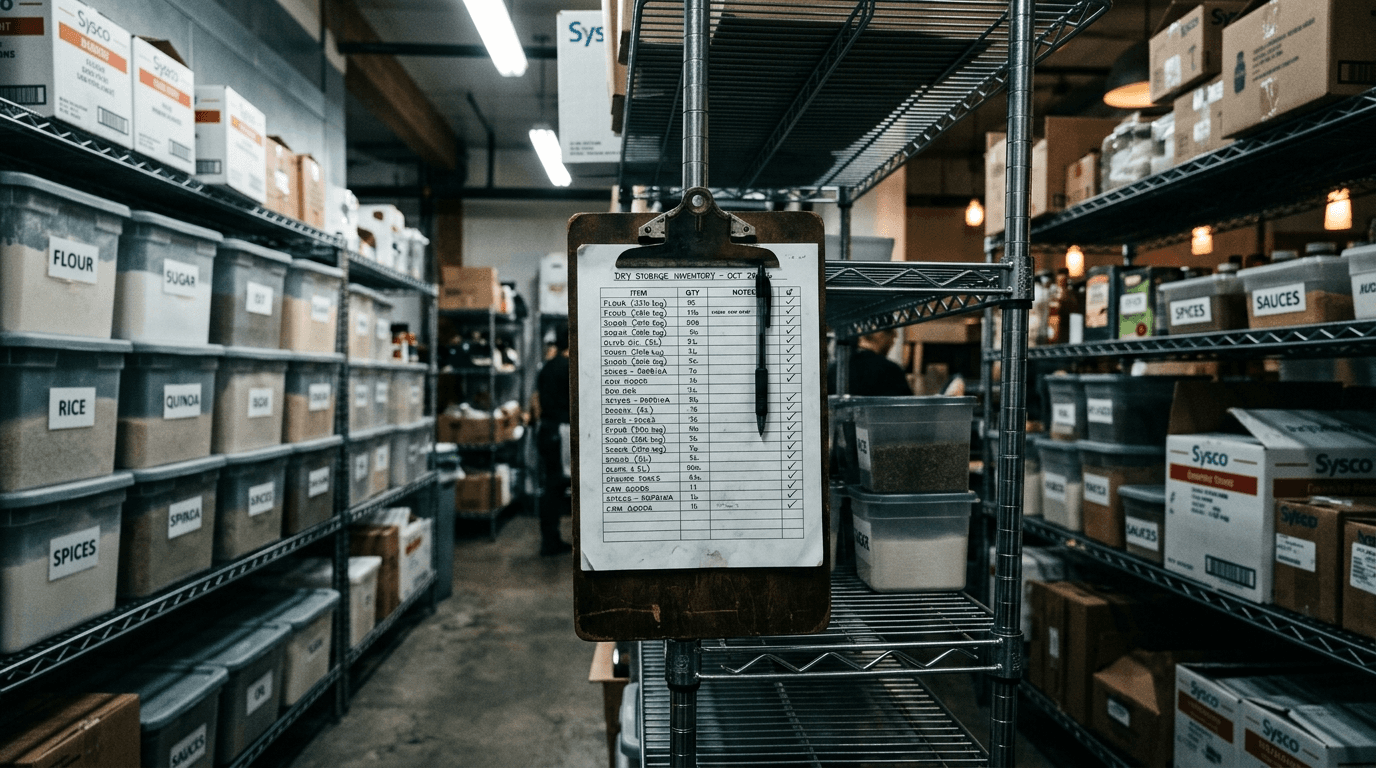
How often should you stocktake?
Short answer: monthly if you want to keep your accountant happy, weekly if you want to control your food cost.
Those two goals aren't the same. Your accountant needs the monthly close. But they look in the rear-view mirror — they tell you how last month went. To decide now — adjust an order, catch a portion drift, spot theft or waste — you need a weekly stocktake.
Monthly vs weekly: what each frequency really gives you
| Criterion | Monthly stocktake | Weekly stocktake |
|---|---|---|
| Real food cost available | Day +20 to +30 | Day +1 (next day) |
| Loss detection | Too late to fix | Within the following week |
| Average duration | 3 to 4 hours | 15 to 20 minutes |
| Data reliability | Often estimates | Based on actual physical count |
| Useful for orders | Limited | Directly usable |
| Regulatory requirement | Accounting minimum | Operational best practice |
Monthly is the floor. Weekly turns the stocktake from an accounting chore into a live management tool. To go further on the stock-orders link, read supplier orders driven by stocktake — it changes how you place orders.
How to run a fast restaurant stocktake
Stocktakes drag for two reasons: you don't know which order to walk, and you enter the numbers into something that gives you nothing back. Here's how to cut it to 20 minutes.
1. Lock in a single route and never change it. Always the same path: walk-in fridge → freezer → line fridge → dry store → drinks cellar. The repeated route becomes a reflex. Your team can run it without you after three weeks.
2. Pre-list your items in walk order. Your stocktake doesn't start on count day — it's already prepped. Items listed in walk order, with fixed units (kg, L, unit, 4 kg crate). If you change units every week, you waste 15 minutes deciphering last month's numbers.
3. Use a QR scan or mobile app instead of a spreadsheet. If you have QR labels on shelves, the count becomes scan + numeric entry. Otherwise, a tablet with a dedicated app beats a buggy shared spreadsheet a hundred times over. The point: zero re-entry, costing computed automatically. To see how it ties into full FIFO FEFO stock management, it's worth the detour.
4. Cost in real time, not after. The real time saver is not having to rebuild purchase prices after counting. If your stocktake is wired to your price list (the supplier prices), the stock value computes itself as soon as you enter the quantities.
Don't weigh everything. Set a rule: anything above £50 per kilo gets weighed, the rest gets counted in units or estimated by crate. You save 10 minutes without losing precision where it matters.
Case study — Lunch Wagon, going from 4-hour monthly to 20-min weekly
When I took over the Lunch Wagon out of receivership in 2023, the stocktake ran once a month. A Sunday night, two hours of counting minimum, often more. And even then — we weren't sure of the numbers because we had no fixed route, no pre-built list, no automatic costing.
The real problem isn't the 4 hours. It's what you do with the numbers afterward. Honest answer: not much. Last month's food cost lands when your head's already elsewhere, and you move on without changing a thing.
The shift to weekly happened gradually. First 30 minutes, then 25, then 20 once we'd nailed the route and list. What really changed was loss detection: going weekly, we found 15% waste on meats that we couldn't see monthly — leftover service cuts badly wrapped, end-of-week restocking gone wrong. Monthly, those losses drowned in the mass. Weekly, they jumped off the page the next week.
The other effect, and that one I hadn't planned for: the team played along. Not because I asked them to be tidy — because the numbers were live, readable, and they could see directly the link between count discipline and Friday's result. To identify food waste in detail, that's a useful companion read.
Stocktake and HACCP: the link nobody mentions
The stocktake isn't only a control tool — it's also part of your regulatory traceability. A costed, dated stock is proof you control your rotation, you apply FIFO/FEFO and you can rebuild a batch's history in case of a product recall.
In an inspection, a weekly stocktake with dates and batch numbers is a strong argument. A rough monthly stocktake on a spreadsheet is grey area. The HACCP traceability and stock guide explains how the two fit together concretely.
The other direct link: real food cost. Real food cost = opening stock + purchases − closing stock. If your closing stock is a finger in the air, your food cost is too. To understand every input in the formula, the real food cost = stocktake + purchases guide gives the full method.
Common mistakes
Counting solo: you go fast, you estimate, you mess up — and nobody double-checks. Errors compound week after week until the numbers stop meaning anything.
- Changing units week to week. One week in kg, the next in 2 kg trays — impossible to compare. Fix the units once and never touch them again.
- Costing by guess. Slapping "roughly £4/kg on veg" instead of the real invoice price skews your food cost by 5 to 8 points without you knowing.
- Counting after service. End-of-service stock is the least reliable — half-prepped ingredients everywhere, prepped items not sold. Best moment: before opening or in the break, with stock stabilised.
- Not separating storage from mise en place. What's in the walk-in and what's already on the line don't count the same way. Split the columns or you'll either double count or miss it.
Conclusion
Three things to take away to turn your stocktake into a control tool:
1. Monthly isn't enough for control. It satisfies your accountant, not your daily management. If your food cost lands three weeks late, you decide blind.
2. Going weekly happens in two steps. First, fix a route and a standard list — you go from 4h to 45 min. Then wire it to your price list — you hit 20 min with automatic costing.
3. Stocktake isn't a chore if you do something with it. The team plays along when the numbers are readable and the results visible. The rest follows.
Tu veux voir comment Onrush gère ça sur ton restaurant ?
Démo 20 min, sans engagement. On regarde tes vrais chiffres.
Demander une démo →Articles liés
Restaurant stock management: complete guide 2026 (FIFO, stocktake, food waste)
Stock management: FIFO/FEFO method, stocktake frequency, costing, food waste. Software vs spreadsheet.
Restaurant food waste: identify and reduce in 2026
Food waste: typology (breakage, expiry, over-portioning, theft), measurement method, reduction levers.
Best HACCP software 2026: comparison + criteria (top 5)
2026 comparison of restaurant HACCP software: temperature logs, food safety management, mobile, EHO alerts. Top 5 reviewed.
Best food cost software 2026: comparison + selection criteria
2026 comparison of restaurant food cost software: price cascade, theoretical/actual, POS integrations. Top 5 reviewed.
Last updated 2026. Written by Cyril Quesnel, founder of Onrush, chef-entrepreneur (La Verrerie 2015-2018, Lunch Wagon 2023-2026).