Cut your food cost: 7 concrete levers (2026 Guide)
Food cost at 32%? 7 levers you can pull this week to gain 3 to 5 points of margin. Field-tested method across 2 restaurants.
The short version. Your food cost is over 32%? There are 7 levers you can pull this week without touching your prices. At La Verrerie, I went from 36% to 28% in 90 days — that is +£28,000/year recovered on £800,000 of turnover. The method: recipe cards, purchasing, waste and inventory in parallel. In that order.
Context / Definition
Food cost is the indicator that separates a restaurant that runs from one that sinks — often without the chef noticing before the year-end accounts. It is the ratio between what you spend on raw materials and what you take in. If you sell £1,000 of plates in a day and your ingredients cost you £320, your food cost is 32%. Simple to calculate. Hard to control when you are running 40 covers solo with 3 suppliers and a brigade that turns over every six months. Before reducing, you need to understand what food cost actually is and what it really measures.
Food cost: share of raw material cost in turnover, expressed as a percentage. A 30% food cost means 30 pence of every pound taken goes into ingredients.
What is the right food cost level to aim for?
Direct answer: between 28% and 32% for a bistro or traditional restaurant. Below 28% for a fine dining establishment where perceived value justifies higher prices. Above 35%, it is an emergency.
These thresholds are not gospel. They are the result of what we see in healthy operations — those that pay themselves properly, service their debt and breathe a little. A 38% food cost does not kill you in a month. It bleeds you slowly, month after month, until the year-end accounts where you discover the year was decided on 4 points of margin you never saw leaving.
Benchmarks by restaurant type (2026)
| Restaurant type | Target food cost | Alert threshold |
|---|---|---|
| Bistro / brasserie | 28 – 32% | > 35% |
| Fine dining | 25 – 30% | > 33% |
| Quick service | 25 – 28% | > 32% |
| Food truck | 28 – 33% | > 37% |
| Pizzeria | 22 – 28% | > 32% |
To know where you actually stand, start by calculating your exact theoretical food cost — not just the rough one.
The 7 levers to cut your restaurant food cost
These are not 7 abstract ideas. This is the list of actions I activated in this order at La Verrerie. Some had effect within a week. Others took 30 days to show on the numbers.
1. Refresh every recipe card
This is the starting point. Without precise recipe cards, you are flying blind. Every dish needs a defined grammage, a calculated ingredient cost, a selling price aligned with your margin target. If your cards date from opening and supplier prices have moved, your theoretical food cost is wrong — and you cannot correct anything on a wrong base. Learning to keep your recipe cards updated continuously is competency #1 of an operator who manages.
2. Renegotiate or change supplier on volume lines
Not all at once. On the 3 to 5 lines that weigh most in your purchasing. Flour, meat, dairy depending on your menu. A price comparison takes 2 hours. The saving can change your cost structure for 12 months.
3. Train the team on weighing
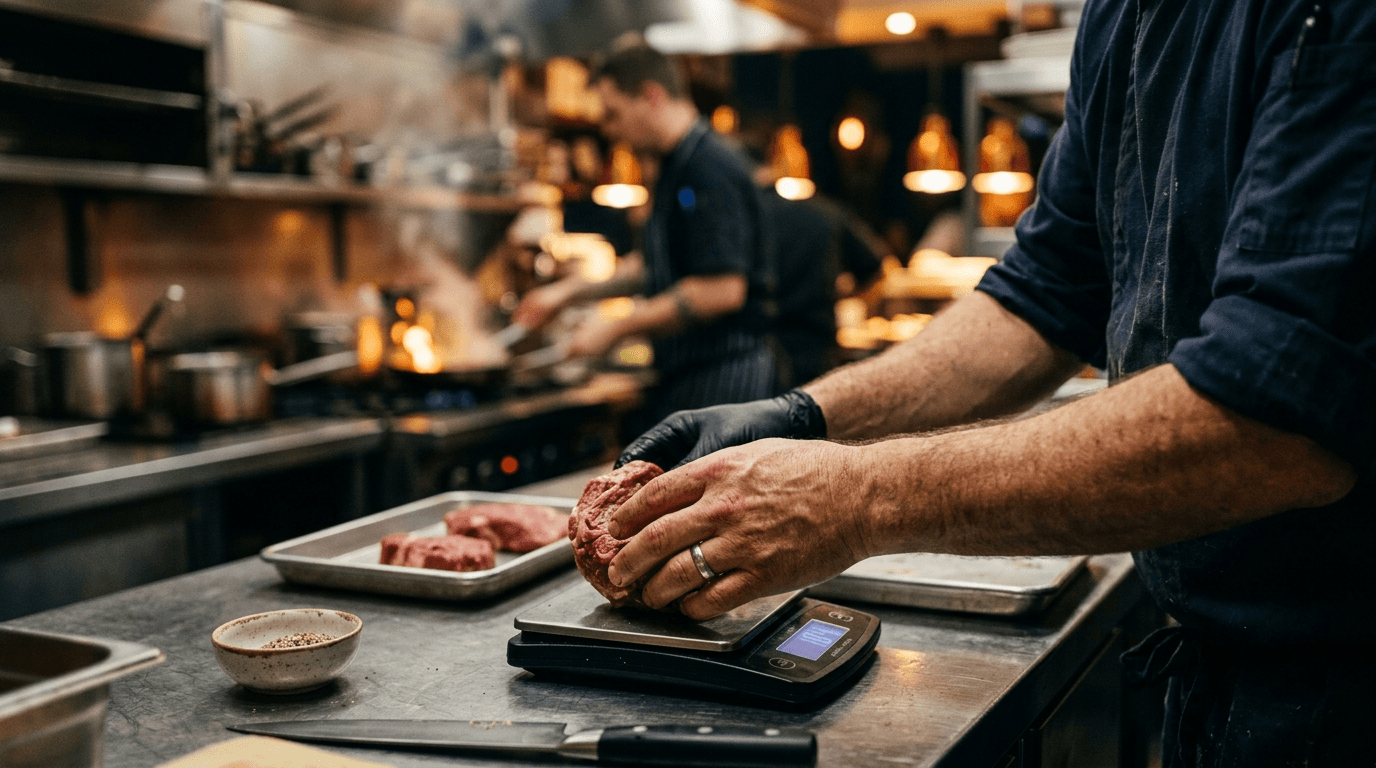
This lever is underrated. When every prep cook puts an extra 30g of cheese on every pizza, across 80 covers per service, you lose the equivalent of several food cost points without noticing. Grammage training is not policing — it is consistency between what you planned and what you produce.
4. Set up a weekly inventory
Monthly inventory is too slow. By the time you see the drift after 4 weeks, it has already cost you. Weekly inventory gives you the visibility to correct within the week. No need for a complex tool at the start — a sheet of paper is enough. What matters is regularity.
5. Streamline the menu
Fewer references means less dormant stock, less waste, less complexity in the kitchen. Every dish removed from the menu simplifies the purchasing chain. Keep what sells well and what margins well. Cut the rest without hesitation. To go further, read cut ingredient losses in the kitchen.
6. Automate supplier orders
When orders are done by gut or out of habit, you over-stock on some lines and lose ingredients. Basing orders on actual sales and actual stock changes everything. Requires discipline at first, then becomes automatic. Automating supplier orders is the lever that locks in the gains from the others.
7. Track food cost daily, not at year-end
The last lever is visibility. A food cost read once a year cannot be managed. A food cost read every week can be steered. A daily profitability dashboard lets you see drift before it costs.
Hit levers 1 and 2 first. Up-to-date recipe cards + renegotiation on volume lines = the two actions with the fastest, most measurable impact. The others consolidate the gain.
Case study — La Verrerie, Gaillac (2016-2017)
When I took over La Verrerie out of administration in 2015, I had £300,000 of turnover and margins I did not really understand. The number was climbing. But it did not show enough on cash. I eventually measured food cost properly. It was at 36%. Too high for a hotel-restaurant doing bistronomy with a decent average ticket.
I spent 3 months working in order: cards first. 48 recipe cards recalculated, with current supplier prices — not the ones from two years back. On some dishes, the gap between assumed theoretical food cost and actual was 5 to 8 points. That explained a lot. Then purchasing. On flour — a heavy line for a place doing bread and pastry — I compared 3 suppliers. 18% saving by switching flour supplier, equivalent quality. No miracle, just a comparison I had not run since opening.
In parallel: team training on weighing, weekly inventory without exception, and removing 3 menu lines that did not sell and tied up dead stock. Result after 90 days: food cost at 28%. 8 points recovered. On £800,000 of annual turnover, that was +£28,000 of gross margin per year — without touching a single selling price.
Common mistakes
Starting with a price increase rather than fixing cards and purchasing. A price increase is the last lever — it risks losing customers before you have optimised what is in your hands.
- Working only on theoretical. Cards updated but no actual tracking = you steer on a map that no longer matches the ground.
- Doing inventory once a month. Too late to correct. Weekly is the right rhythm.
- Renegotiating every line at once. Takes too long and dilutes the effort. Prioritise the 3 lines that weigh most.
- Training the team once and never coming back. Weighing habits fade in 3 weeks without reinforcement.
- Confusing lower food cost with cutting quality. The 7 levers above do not touch product quality — they correct waste, gaps and badly optimised purchasing.
Conclusion
Food cost is something you steer — not something you endure. Three points to take away:
- Start with the recipe cards. If they are wrong or stale, everything else sits on sand. 48 cards recalculated takes time. It changes the numbers.
- Purchasing is under-optimised in most operations. Comparing 3 suppliers on your volume lines takes 2 hours. The gain lasts 12 months.
- Visibility is the real lever. A food cost read every week can be managed. A food cost discovered in the year-end P&L is endured.
36% to 28% in 90 days — it is doable. Not with miracles. With order.
Si t'as aimé cet article, lis celui-ci ensuite :
→ Best food cost software 2026: comparison + selection criteria↗Articles liés
Best food cost software 2026: comparison + selection criteria
2026 comparison of restaurant food cost software: price cascade, theoretical/actual, POS integrations. Top 5 reviewed.
Food cost: how to calculate it precisely (formula + worked example)
Theoretical food cost formula, actual food cost, food cost per dish. Worked numbers + free worksheet.
Food cost in restaurants: the complete 2026 guide (calculation, levers, software)
Food cost: definition, theoretical vs actual calculation, target ratios by restaurant type, 7 levers to bring it down. Field method + free tool.
Restaurant menu engineering: optimising your menu profitability (2026)
Menu engineering: popularity × margin matrix, stars vs dogs, repositioning method. Add 3 to 7% revenue.
Last updated: 2026. Written by Cyril Quesnel, founder of Onrush, chef and operator (La Verrerie 2015-2018, Lunch Wagon 2023-2026).