Recipe card restaurant: a real-world downloadable example (2026)
A complete recipe card example: Beef Tartare — gram weights, cost, allergens, margin. Free downloadable template.
TL;DR. A restaurant recipe card is one card per dish with gram weights, plate cost, allergens and your margin. On the Lunch Wagon Beef Tartare: £4.20 plate cost, £18 ex-VAT selling price, 23% food cost, £13.80 gross margin. I break down every line here, with a downloadable template at the end.
Context / Definition
A restaurant recipe card is the reference document that holds everything about how a dish is made: ingredients, gram weights, method, plate cost and allergens. It's the foundation of how you run the place. Without it, you cook on instinct — and you steer your margins blindfolded. To understand why recipe cards matter, the real question isn't "do I need this" but "why don't I have it yet."
Restaurant recipe card: one document per dish that lists ingredients with their precise gram weights, the calculated plate cost, the regulatory allergens and the gross margin generated.
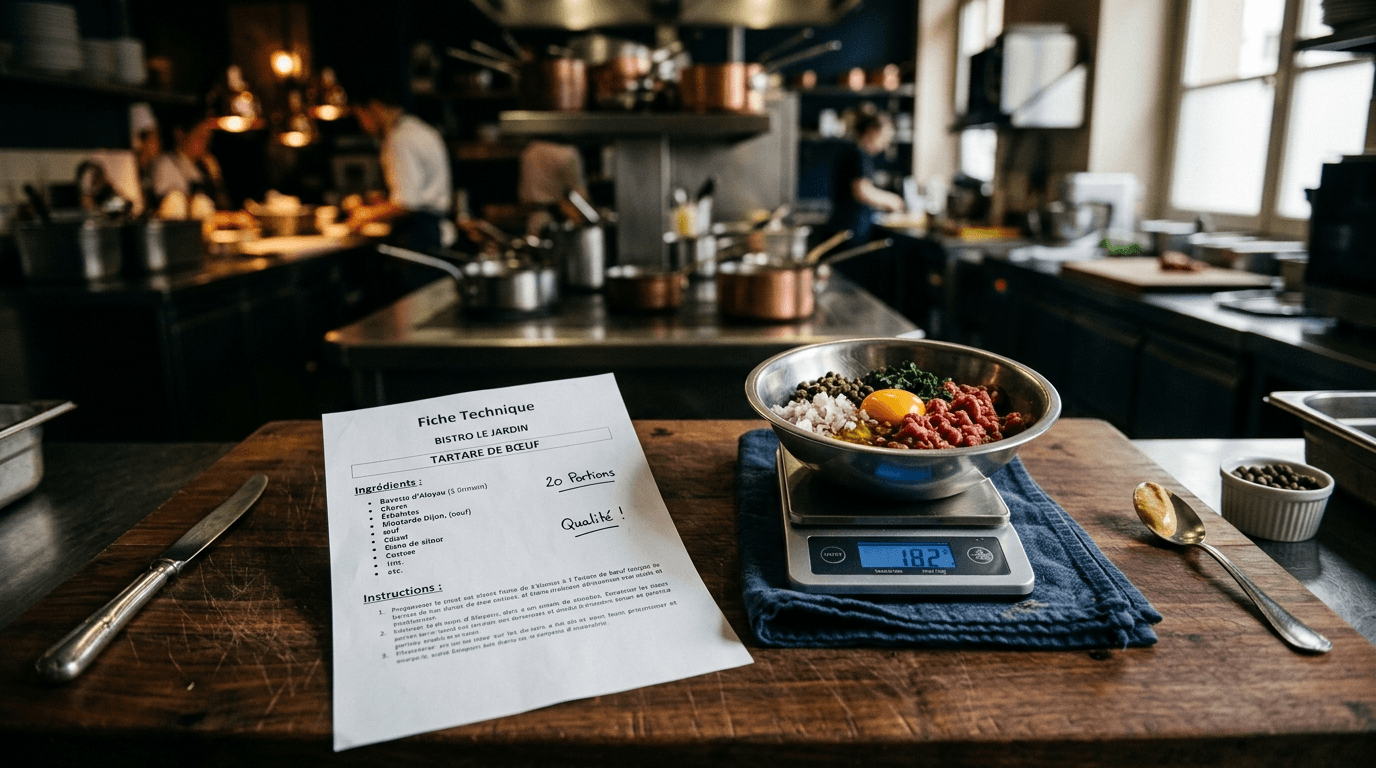
What does a recipe card actually look like?
A well-built recipe card fits on one page. Not more. The goal isn't to write a dossier — it's to have an operational reference any brigade member can read in 30 seconds.
Here's what it contains, line by line.
The header
- Dish name: Lunch Wagon Beef Tartare
- Category: Main course
- Number of portions: 1 (always work per portion)
- Created / updated date: important for traceability
The ingredient table
This is the heart of the card. Each ingredient appears with:
- Its exact name (bavette, not just "beef")
- The net weight in grams (after trimming)
- The unit price per kilo or litre (pulled from your supplier mercurial)
- The calculated cost for the portion
The allergens block
Legally mandatory under EU FIC Regulation 1169/2011 (UK retained). The 14 allergens to declare have to be identified on every card. Missing one during an Environmental Health visit is a direct improvement notice.
The cost and margin block
- Total plate cost (sum of all ingredients)
- Selling price ex-VAT
- Food cost = plate cost / selling price ex-VAT × 100
- Gross margin = selling price ex-VAT − plate cost
This block tells you whether your dish is viable. For the plate cost calculation in detail, the rules are precise — don't improvise them.
How to build your recipe card step by step
- Pick the reference portion — always 1 portion, never 10. Multiply later.
- List every ingredient — including condiments, cooking oils, herbs. Everything counts.
- Weigh each ingredient NET — after peeling, trimming, boning. Not gross.
- Pull prices from your mercurial — a price 6 months old isn't reliable anymore.
- Identify allergens — for each ingredient, tick the allergens present.
- Calculate the margin — and decide whether the selling price is coherent.
- Date the card — and update it on every supplier change.
Start with the 5 dishes that sell the most. Not all dishes at once. You'll never finish if you go at the whole menu in one go — and you'll end up with sloppy cards instead of 5 solid ones.
Real case — Beef Tartare, Lunch Wagon 2025
In 2025, the Beef Tartare was one of the signature dishes at the Lunch Wagon in Albi. Here's its real recipe card, broken down.
| Ingrédient | Grammage | Prix | Coût |
|---|---|---|---|
| Bavette (skirt) | 160 g | £18.50/kg | £2.96 |
| Capers | 25 g | £8.00/kg | £0.20 |
| Shallot | 20 g | £3.50/kg | £0.07 |
| Cornichons | 30 g | £4.20/kg | £0.13 |
| Egg yolk | 1 piece | £0.28/piece | £0.28 |
| Mustard | 10 g | £6.00/kg | £0.06 |
| Worcestershire sauce | 5 ml | £9.00/L | £0.05 |
| Tabasco, salt, pepper | PM | — | £0.10 |
| Toasted bread (2 slices) | 60 g | £3.80/kg | £0.23 |
| Mesclun salad | 40 g | £7.00/kg | £0.28 |
| Olive oil (plating) | 5 ml | £8.00/L | £0.04 |
23% food cost on a tartare is a good ratio. The dish justifies its price because the protein is decent (skirt steak, not industrial mince) and the card was built knowing the exact price of every ingredient. Without a recipe card, I'd have ballparked it at "around £5" — and I'd never have known whether the margin was at 20% or 30%.
That kind of precision is what later lets you run menu profitability without guesswork.
Recipe card: paper, Excel or dedicated software?
Three options still coexist in 2026. Their real difference isn't price, it's the time you lose when a supplier price moves.
- Card creation
- 30 min + photocopy
- Price update
- Impossible to keep up
- Allergens
- Eraser + pencil
- Live food cost
- No
- Environmental Health visit
- Stress
- Card creation
- 20 min per dish
- Price update
- 5 min × 40 cards = 3h30
- Allergens
- Cell by hand, miss risk
- Live food cost
- Only if everything recalculated
- Environmental Health visit
- OK if well kept
- Card creation
- 8 min per dish
- Price update
- Invoice OCR → auto cascade, 0 min
- Allergens
- Tied to the mercurial ingredient
- Live food cost
- Recalculated on every change
- Environmental Health visit
- Instant PDF export
Excel works if you actually use it. But the second skirt steak goes up £1.50/kg at your supplier, you have to reopen every card that uses it and recalculate. On 40 cards, that's half a day. With auto-cascade software, it's 30 seconds.
Common mistakes
Working at gross weight rather than net weight is the most expensive mistake. If you put 200g gross of skirt in your card without deducting the trim, your cost is underestimated by 10 to 15%. Your displayed margin is wrong. Your selling price is too low.
- Forgetting the "small" ingredients — oil, salt, herbs, condiments. On their own they look trivial. Stacked across 50 plates per service, they can be 3 to 5% of your food cost.
- Not dating your cards — a card built in 2023 with 2023 prices is worthless in 2026. Raw materials have moved.
- Building cards for Environmental Health, not for running the place — a recipe card isn't an admin document. It's your management tool. If you only build it for an inspection, you miss 80% of its value.
- Building cards that are too complex — an unreadable card won't be used by the brigade. 1 page, clear, fast.
Conclusion
A restaurant recipe card is three things in one: a margin management tool, a regulatory traceability document, and an operational reference for your brigade.
The Lunch Wagon Beef Tartare illustrates it concretely: £4.20 plate cost, £18 ex-VAT selling price, 23% food cost, £13.80 gross margin. Those numbers only exist because the card was built properly, ingredient by ingredient, net weight by net weight.
Without a recipe card, you estimate. With an up-to-date recipe card, you run things.
Tu veux voir comment Onrush gère ça sur ton restaurant ?
Démo 20 min, sans engagement. On regarde tes vrais chiffres.
Demander une démo →Articles liés
Best restaurant software 2026: the complete comparison (top 10)
2026 comparison of restaurant management software: food cost, recipe cards, HACCP, stock, ordering. Selection criteria + comparison table.
Recipe card restaurant: the complete 2026 guide (template + software)
Recipe card: structure, allergens, plate cost, gram weights, automatic updates. Free template + field-tested method.
Allergens in restaurants: 2026 obligations (FIC + 14 allergens)
The 14 allergens you must declare, display formats, penalties. A method so nothing slips through the kitchen.
Best food cost software 2026: comparison + selection criteria
2026 comparison of restaurant food cost software: price cascade, theoretical/actual, POS integrations. Top 5 reviewed.
Last updated 2 May 2026. Written by Cyril Quesnel, founder of Onrush, restaurateur (La Verrerie 2015-2018, Lunch Wagon 2023-2026).