Recipe card restaurant: the complete 2026 guide (template + software)
Recipe card: structure, allergens, plate cost, gram weights, automatic updates. Free template + field-tested method.
TL;DR. A restaurant recipe card is the document that describes a dish from A to Z: ingredients, gram weights, method, allergens, plate cost, selling price and margin. Mandatory on the allergens side (EU FIC Regulation 1169/2011, UK retained), essential everywhere else to run your margins. The trap: a recipe card frozen in an 18-month-old Excel sheet is worth nothing. Here's how to make it a living tool.
Context / Definition
The recipe card is the basic unit of running a professional kitchen. It documents every dish, every mother sauce, every base side — with the exact gram weights, the cooking method, the allergens present, and the cost it represents at the moment you read the number. Without it, you cook on instinct. With a frozen card, you work off stale data. The difference between the two is the difference between running the kitchen and being run by it.
Restaurant recipe card: reference document that describes a dish or preparation with its ingredients, gram weights, method, allergens, plate cost and selling price, updated every time a raw material price moves.
What is a recipe card in restaurants?
A restaurant recipe card is a dish's ID card. It answers a single question: how much does this actually cost me to produce, and am I selling it at the right price?
It contains seven blocks of information. None is optional if you want to run the place properly.
The 7 blocks of a complete recipe card
1. Dish identification Name, category (starter, main, dessert), number of portions in the recipe, expected yield.
2. Ingredient list with gross and net gram weights Gross weight is what you put on the scale before peeling, trimming or cooking. Net weight is what lands on the plate. The gap between the two is the loss coefficient — often ignored, always expensive.
3. Unit price for each ingredient Pulled from your current mercurial. Not the one from six months ago. Today's.
4. Plate cost The sum of all ingredients at net weight, divided by the number of portions. That's the number that runs your margin. To get the plate cost calculation fully nailed down, a dedicated article walks you through it step by step.
5. Allergens The 14 regulatory allergens in 2026 (see dedicated section below). Legally mandatory. A miss is a customer safety failure and an FSA / Environmental Health risk.
6. Cooking method Prep steps, cooking temperatures, resting times. Essential for brigade reproducibility and HACCP traceability.
7. Selling price and margin The price you put on the menu, and the food cost percentage it represents. If your food cost on this dish is over 33%, you have a decision to make.
How to build a restaurant recipe card?
Building a recipe card takes 20 to 45 minutes per dish from scratch. The challenge isn't creating them — it's keeping them updated. Here's the five-step method.
Step 1: Actually weigh things No estimating. No "around 150g of fillet." You weigh. You write down gross and net. You calculate the loss coefficient = (gross − net) / gross × 100. A fish fillet at 30% loss isn't £12/kg — it costs you £17.14/kg in net portion.
Step 2: Source every ingredient from your current mercurial Each ingredient is tied to a supplier, a reference, a current purchase price. This is where the card lives or dies. If you key a price in by hand and don't update it when your supplier shifts rates, your card lies. To get a live supplier mercurial, the topic deserves its own article.
Step 3: Calculate total plate cost Plate cost = Σ (net weight × unit price per kg/litre) for all ingredients, divided by number of portions.
Step 4: Fill in the 14 mandatory allergens for 2026 Each ingredient either carries an allergen or doesn't. The card consolidates the allergens present in the dish automatically. For the exact regulatory list, the article on mandatory allergens 2026 covers it in full.
Step 5: Set the selling price and calculate the margin Food cost % = plate cost / selling price ex-VAT × 100. Target: 28% to 33% depending on your positioning. Above 35%, you're working to pay your suppliers.
The first time you build your cards, do it in menu order. Start with your top 5 sellers. That's where 80% of your margin lives. The rest can wait a week.
Real case — La Verrerie, Gaillac, 2016
When I took over La Verrerie in 2015, the place was in receivership. 14 rooms, spa, bistronomy. Turnover around £300k. While doing the initial audit, I dug out an Excel binder with 48 recipe cards. Well done, complete, clean. Dated 2014.
I took the 48 cards. I went back through every ingredient with prices current at the time of the recalculation, early 2016. Result: 67% of raw material prices were stale. On some dishes, real plate cost was 18 to 24% higher than what was calculated on the card. The restaurant was selling these dishes at a price set against numbers 18 months old, in a context where ingredient costs had moved.
The problem wasn't that the cards were badly built. The problem was they were frozen. Nobody updated them because it's a huge job to do manually — for each card, you have to find every ingredient, fix the price, recalculate. With 48 cards and a brigade busy running services, it just doesn't happen.
That discovery put me in front of a simple reality: a recipe card frozen in Excel is the illusion of control. You think you're running your margins. You're running stale data.
That's one of the experiences that planted the seed for Onrush, years later. The tool had to do what nobody does manually: recalculate every card the second a price moves.
For a recipe card real-world example with the actual numbers, a dedicated article walks you through building one step by step.
Frozen card vs living card
This is the real 2026 stake. Not whether you make recipe cards — everyone does. But whether they reflect today's actual ingredient cost.
- Supplier price hike update
- 5 min × affected card
- Cross-card consistency
- Zero guarantee
- Allergens
- Edited by hand
- Real-time plate cost
- No
- Human error
- High
- Monthly maintenance
- 3 to 6 hours
- Supplier price hike update
- Automatic, 0 min
- Cross-card consistency
- Auto cascade
- Allergens
- Tied to the mercurial
- Real-time plate cost
- Yes
- Human error
- Low
- Monthly maintenance
- 15 to 30 min
The concrete difference: when your supplier raises butter by 12%, a living card recalculates in cascade the 14 cards that contain butter. You see immediately which dishes are hit and by how much. With Excel, you find out at year-end. That's exactly what I cover in the article on how to cut your overall food cost.
The 14 mandatory allergens in 2026
EU FIC Regulation 1169/2011 (UK retained) requires you to declare 14 allergens in every catering business. Your recipe card is where this information has to be documented at source — ingredient by ingredient.
The 14 allergens to track:
- Cereals containing gluten (wheat, rye, barley, oats, spelt, kamut)
- Crustaceans
- Eggs
- Fish
- Peanuts
- Soybeans
- Milk and dairy
- Tree nuts (almonds, hazelnuts, walnuts, cashews, pecans, pistachios, Brazil nuts, macadamia nuts)
- Celery
- Mustard
- Sesame seeds
- Sulphur dioxide and sulphites (> 10 mg/kg or 10 mg/L)
- Lupin
- Molluscs
Specific legal obligation: you must be able to communicate the allergens present in a dish to any customer who asks, verbally or in writing. The FSA / Environmental Health can audit your traceability. Missing documentation is non-compliance.
Best practice: every ingredient in your mercurial carries its allergens. The recipe card consolidates them automatically. If you switch suppliers for an ingredient, the allergen info updates at source.
How many recipe cards for a menu?
The field rule: 1 card per finished dish + 1 card per mother sauce + 1 card per base side.
A 25-dish menu actually needs between 60 and 75 recipe cards. Because a beurre blanc that goes with 4 different dishes deserves its own card — and the 4 dishes reference it. When butter goes up, you update one card, and the 4 dishes are recalculated.
That's the cascade logic. And that's why Excel is structurally unfit for the problem: Excel doesn't reliably handle dynamic links between cards as your menu evolves.
| Card type | Typical count for a 25-dish menu |
|---|---|
| Finished dishes | 25 |
| Mother sauces & stocks | 8 to 12 |
| Base sides | 10 to 15 |
| Composed desserts | 5 to 8 |
| Estimated total | 48 to 60 cards |
Common recipe card mistakes
Using prices "from memory" or rounded figures rather than the actual prices on your latest supplier invoice. A 5% error per ingredient, on 8 ingredients per dish, can shift your real food cost by 3 to 4 points. On a 150-cover service, that's hundreds of pounds of margin you think you have and that don't exist.
Mistake 1: Forgetting the loss coefficient You note 200g of carrot per portion. But you're starting from whole unpeeled carrots. Loss to peeling and trimming is 20 to 25%. The real cost of the portion isn't 200g — it's 250 to 260g gross. Across 80 portions per service, it changes your plate cost.
Mistake 2: Creating cards and never reviewing them That's La Verrerie's mistake. A card built in 2014 and never updated lies in 2016. In 2026, with raw material volatility, a card that hasn't been updated in 6 months is suspect.
Mistake 3: Only making cards for main dishes Desserts, amuse-bouches, in-house breads and sauces are often forgotten. Yet a dessert at 38% food cost — because no one ever calculated its real cost — drags the overall margin down.
Mistake 4: Not linking the recipe card to orders Your recipe card says one tartare portion needs 180g of net beef. If you don't tie that info back to your stock and your supplier orders, you have information without a decision. The end goal of a recipe card is to know what to order, in what quantity, at what cost.
Mistake 5: Treating allergens as a tickbox The allergen on your recipe card has to be tied to your ingredient, not jotted in by hand at the bottom of the table. If you switch suppliers for your crème fraîche and the new product contains traces of soy lecithin, you need to see it. Otherwise your allergens documentation is wrong even if it's "filled in."
Recipe card by hand vs software: which to choose?
There's no universal right answer. There's an answer based on where you are.
| Situation | Recommendation |
|---|---|
| You're starting out, 8-dish menu, zero budget | Excel or free template to begin |
| You have 15+ dishes and a supplier whose prices change regularly | Software is essential |
| You want to be ready for an Environmental Health visit | Software with built-in HACCP module |
| You run multiple sites | Multi-site software is mandatory |
| You've never calculated your real food cost | Start with a card by hand to understand, then move to a tool |
For a complete comparison of available solutions, the article on recipe card software 2026 covers the market with the criteria that actually matter.
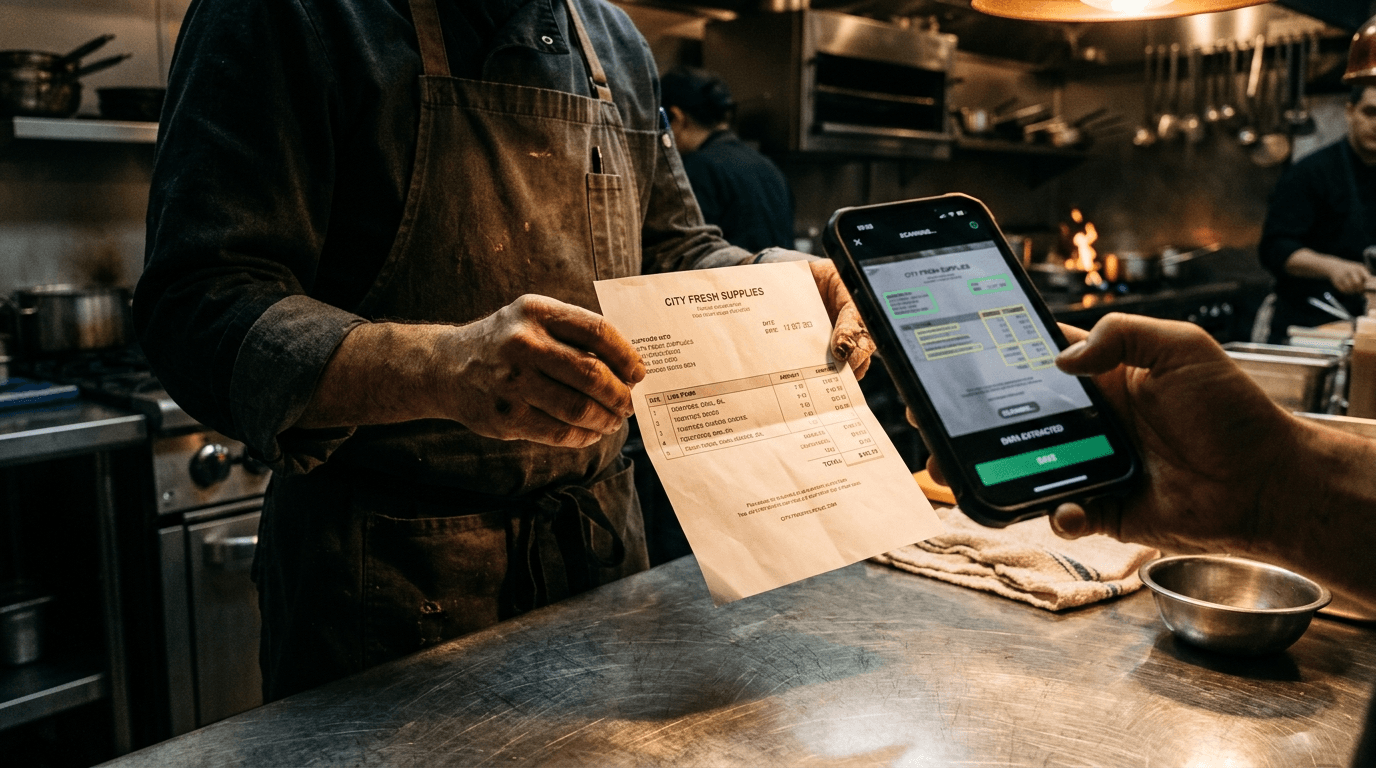
The flow with software: you snap your supplier invoice, OCR updates the prices in your mercurial, and every recipe card containing those ingredients is recalculated automatically. 5 minutes of invoice processing. 0 minutes of manual updating. It's the inverse of the Excel model.
Conclusion
Three takeaways from this guide.
1. A recipe card is a living tool or it's worth nothing. A card frozen for 18 months in Excel gives you the illusion of running things. In reality, you're making pricing and menu decisions on stale data. I lived it at La Verrerie. 67% of prices stale. Dishes sold at a loss without knowing.
2. Allergens are not optional. 14 regulatory allergens in 2026. Your recipe card is the starting point of your traceability. If your ingredient changes supplier, the allergen info has to update at source — not in a table jotted in by hand.
3. The Excel → software move isn't a luxury once your menu hits 15 dishes. That's the threshold where manual upkeep becomes unmanageable. 5 minutes per frozen card per supplier change × 60 cards = 5 hours wasted. With a tool, it's 0 minutes.
1 email par semaine, les vrais chiffres du métier
Pas de marketing. Des données terrain, des cas concrets, des retours d'équipe.
Je m'inscris →Articles liés
Recipe card restaurant: a real-world downloadable example (2026)
A complete recipe card example: Beef Tartare — gram weights, cost, allergens, margin. Free downloadable template.
Allergens in restaurants: 2026 obligations (FIC + 14 allergens)
The 14 allergens you must declare, display formats, penalties. A method so nothing slips through the kitchen.
Food cost: how to calculate it precisely (formula + worked example)
Theoretical food cost formula, actual food cost, food cost per dish. Worked numbers + free worksheet.
Restaurant menu engineering: optimising your menu profitability (2026)
Menu engineering: popularity × margin matrix, stars vs dogs, repositioning method. Add 3 to 7% revenue.
Last updated 2 May 2026. Written by Cyril Quesnel, founder of Onrush, restaurateur (La Verrerie 2015-2018, Lunch Wagon 2023-2026).