Restaurant mercurial: tracking supplier prices live (2026)
Mercurial: definition, Excel vs software, automatic cascade onto recipe cards. Recover 3 points of food cost.
TL;DR. A restaurant mercurial (supplier price list) is your raw materials list with current supplier prices and the date logged. It's the foundation of your food cost. Without it current, you sell at a loss without realising. Excel holds up to 20 SKUs. Beyond that, a tool with automatic cascade onto recipe cards becomes non-negotiable to recover 2-4 points of margin.
Context / Definition
The restaurant mercurial (supplier price list) is a management tool as old as professional kitchens. In its simplest form it's a list. But it's a list that, kept current or ignored, makes all the difference between margin in control and food cost drifting silently.
Restaurant mercurial: list of every raw material purchased, with the current supplier price, the date last logged, and the unit of measure. The reference for calculating the real cost of every recipe card.
The mercurial isn't an accounting document. It isn't a P&L. It's a living tool — or a dead one. The gap between the two is several thousand pounds a year.
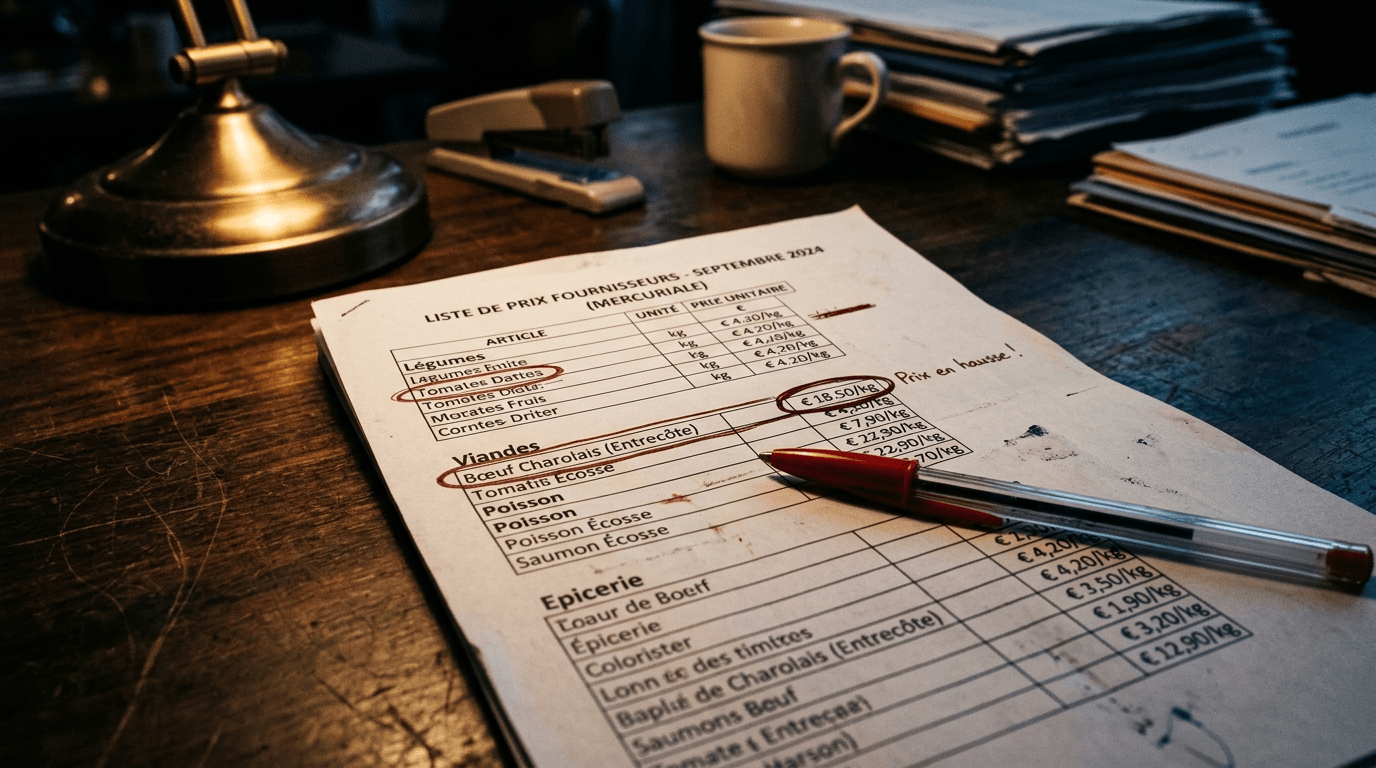
What's a supplier mercurial and why is it critical?
The mercurial is the starting point for any serious food cost calculation. Without current supplier prices, your recipe cards spit out the wrong numbers. You think you're running 28% food cost. You're actually at 32%. You don't see the gap until the year-end P&L.
The problem isn't lacking a mercurial. Most operators have one. The problem is it isn't current. Prices move every month — sometimes every week on fresh produce. A static mercurial is an illusion of control.
What a complete mercurial contains
| Column | Content | Example |
|---|---|---|
| Product reference | Exact name as it appears on the invoice | Plain flour, 25 kg sack |
| Supplier | Vendor name | Bidfood / Brakes / local |
| Unit price ex-VAT | Price on the latest invoice | £18.40 |
| Unit of measure | Basis for recipe card calculation | kg / litre / each |
| Date logged | When was it last updated | 12/04/2026 |
| Variation % | Difference vs previous log | +6% |
Six columns minimum. If you use several suppliers for the same SKU, add a line per supplier and compare.
How to keep your mercurial current without burning your life on it
The right update frequency is every invoice received. Not once a month. Not once a quarter. Every invoice.
In practice that means:
- You receive the supplier invoice — paper or email
- You spot the items whose price has moved — usually 2-5 lines per invoice
- You update the prices in your mercurial — 5 minutes if it's structured
- Your mercurial pushes the new prices to your recipe cards — automatic with software, manual otherwise
- Your food cost recalculates — in real time or at your next review
In Excel, steps 4 and 5 add 20-40 minutes for every update. For a venue receiving 3-5 supplier invoices a week, that's quickly unmanageable.
When an invoice looks like the previous ones, it doesn't mean prices are identical. Quiet 3-4% hikes slip past in manual mode. Those are the most dangerous because they compound without triggering any alarm.
For more on the order side, here's how to automate your supplier orders starting from the mercurial.
Case study — La Verrerie, 2016
In 2016, at La Verrerie in Gaillac, I kept my mercurial in Excel. I updated it every two or three months. That was already better than nothing — most chefs had nothing at all.
End of year, redoing my food cost calcs, I compared real purchase prices against my mercurial. T55 plain flour had jumped +18% over the year. Not in one go. In several 4-6% hikes I'd signed off on delivery notes without ever transferring them to the file.
The maths is brutal. Across every prep using that flour — pastry, breads, stuffings — the un-passed-on drift was £2,000 over the year. Silently. Nothing flashed.
It's not a spectacular management mistake. It's exactly the kind of leak good venues absorb for years without ever identifying it.
Since then I've understood the issue isn't discipline. No one can sensibly check 150 SKUs on every invoice by hand. The issue is the tool. If your tool doesn't automatically detect the price gap on invoice receipt, you're exposed to that leak every month.
That's why Onrush includes OCR on supplier invoices: snap a photo of the invoice, items get recognised, prices in your mercurial update, and the price cascade impact on your recipe cards is calculated immediately.
Mercurial Excel vs software: full comparison
| Criterion | Excel | Software with auto cascade |
|---|---|---|
| Up-front cost | £0 | £25-70/month depending on tool |
| Price update | Manual, line by line | Automatic via invoice OCR |
| Cascade onto recipe cards | Manual (20-40 min/update) | Automatic (instant) |
| Price-hike alert | No | Yes (configurable threshold) |
| Manageable SKU count | 20-40 max (unmanageable beyond) | Unlimited |
| Human error risk | High | Low |
| Estimated food cost recovery | Low | 2-4 points possible |
The rule is simple: Excel works up to 20 SKUs maximum. With a 30-dish menu using 5-8 ingredients per dish, you're already past that. A structured purchase order template helps on the buying side, but it doesn't replace a dynamic mercurial.
On £700,000 of revenue, recovering 2 points of food cost is £14,000/year. 4 points is £28,000. It's not a promise. It's the order of magnitude of what a poorly-kept mercurial costs a mid-sized venue.
To see how this lever fits into a wider play, read cut your overall food cost.
Common mistakes on a restaurant mercurial
Updating your mercurial once a quarter is better than nothing. But it's not enough. Over 3 months, volatile commodities (butter, eggs, oils) can swing 15-25%. You buy at the real price, you cost at the price from 90 days ago. You sell at a loss without realising.
-
Not including precise units of measure. If your mercurial says "flour" without specifying the unit (kg, 25 kg sack, 50 kg sack), the recipe card calc is wrong from the start.
-
Keeping a mercurial per supplier instead of per SKU. You want to know what tinned tomatoes cost you, not what Bidfood costs you. Restructure by product reference, not by vendor.
-
Not tracking variations over time. Without history, you don't see trends. A SKU rising +3% per quarter is +12% in a year. Visible only if you keep the old prices.
-
Forgetting secondary products. Fats, spices, aromatics — neglected because they're small per unit. But across 12 months and hundreds of cards, they bite.
Stock management and rotation is the next step once the mercurial is stable: no point ordering at the right price if you don't control your stock levels.
Conclusion
A restaurant mercurial is a simple tool. But simple doesn't mean easy to keep.
Three things to keep:
1. A stale mercurial is a fictional food cost. You're piloting on fake numbers. The decisions you make — adjusting menu prices, switching suppliers, reworking the carte — sit on an inaccurate base.
2. Excel caps out at 20-30 SKUs. Beyond that, the time spent maintaining and propagating changes manually into recipe cards exceeds what the gain justifies. The tool becomes the problem.
3. Automatic cascade is the real lever. It's not just knowing flour went up. It's that the info instantly recalculates every dish using it, and you see real-time impact on margin. That's what lets you decide fast — raise the menu price, sub the ingredient, or absorb knowingly.
On £700,000 of revenue, 2-4 points of food cost recovered is between £14,000 and £28,000 a year. Not from any magic formula — from a current mercurial and a cascade that does the work for you.
Si t'as aimé cet article, lis celui-ci ensuite :
→ Automate restaurant supplier orders: complete 2026 guide↗Articles liés
Automate restaurant supplier orders: complete 2026 guide
Auto-generated supplier orders based on sales + stock, live mercurial, WhatsApp purchase orders. Method + software.
Restaurant purchase order: free template + WhatsApp dispatch (2026)
Restaurant purchase order template PDF + Excel. WhatsApp and email dispatch method, legal format.
Restaurant menu engineering: optimising your menu profitability (2026)
Menu engineering: popularity × margin matrix, stars vs dogs, repositioning method. Add 3 to 7% revenue.
Restaurant KPIs: the essential 2026 dashboard (12 indicators)
The 12 KPIs to track in a restaurant: food cost, labour ratio, average check, revenue per sqm. Sample dashboard + frequency.
Last updated 2026. Written by Cyril Quesnel, founder of Onrush, chef and entrepreneur (La Verrerie 2015-2018, Lunch Wagon 2023-2026).