HACCP temperatures restaurant 2026: the standards (+ logs)
HACCP temperatures restaurant: 2026 standards, cold/hot thresholds, log frequency, penalties. Field-tested method.
In short. HACCP temperatures in a restaurant means 6 zones to monitor, precise thresholds to hold, and logs to document at least 3 times a day. Walk-in fridge between 0 and 3°C, freezer at -18°C minimum, hot holding above 63°C. A tolerance of ±2°C. Below that, it's an improvement notice. Above, it's stock destruction.
Context / Definition
HACCP temperatures are the regulatory thresholds every restaurant operator must monitor, measure and document to prove their cold and hot chains are under control. Not optional. A legal duty that applies from day one of opening, whatever the size of the establishment.
HACCP temperatures restaurant: the set of thermal thresholds defined by retained Regulation 852/2004 and UK food safety guidance, that the operator must respect and trace to ensure food safety at each step of the production chain.
In practice, when an EHO walks into your kitchen, they often start by looking at your temperature logs. Not your menu. Not your decor. Your logs. That's often where it gets complicated — for serious operators, who do good work, but who measure poorly or document incompletely.
For an overview of the legal frame, see the full legal obligations that apply to your establishment.
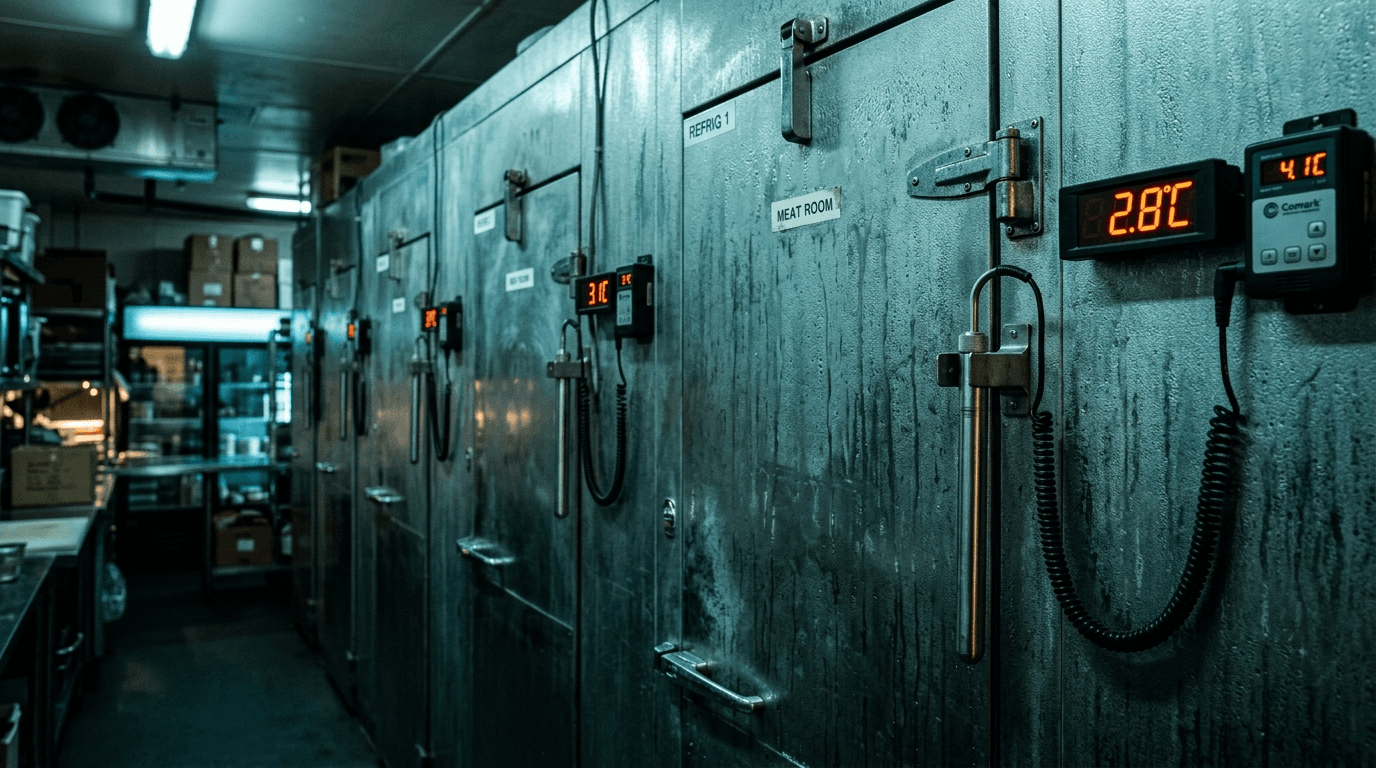
The 6 temperature zones to monitor
There isn't one zone to monitor. There are 6. And they're not interchangeable — each zone has its threshold, its frequency, its logic.
Zone 1 — Walk-in fridge (positive cold)
Threshold: 0°C to 3°C for fresh products (meat, fish, dairy). Some products tolerate up to 5°C — the UK official guidance — but aiming at 2°C day-to-day is best practice. A thermostat set at 3°C that drifts to 5°C after a power blip happens. And it's not visible to the eye.
Zone 2 — Freezer (negative cold)
Threshold: -18°C minimum, no exception. Retained Regulation 852/2004 is explicit. Above -12°C, your products are technically stored out of spec. On inspection, that's a direct hit.
Zone 3 — Cold service (transport, delivery, cold pass)
Threshold: below 5°C (UK guidance; legal absolute is 8°C but 5°C is best practice). This zone is often the worst-controlled. The ice bath that melts, the service that drags on, the bowl of cream sitting on the pass too long — that's where deviations sneak in unnoticed.
Zone 4 — Hot holding (hot pass, bain-marie, trolley)
Threshold: above 63°C core temperature. Not surface. Core. This distinction is what fails on inspection. A bain-marie at 70°C doesn't guarantee the centre of your beef stew is at 63°C. That's where the probe comes in — not the infrared thermometer.
Zone 5 — Reheating
Threshold: reach 75°C core in under 1 hour. A dish out of the fridge going back into the oven needs to climb fast. Slow temperature rise is a bacterial multiplication zone.
Zone 6 — Dry stores and ambient
Threshold: between 15°C and 25°C depending on products. Less critical than cold zones, but checked on inspection for at-risk products (eggs, opened tins, loose spices).
To go deeper into building the full HACCP plan, the HACCP in detail guide covers the entire methodological frame.
How to take your logs: field method
This is the part most operators rush. They have the right kit, they know the thresholds — but their logs are incomplete, irregular, or filled in retroactively. That's exactly what an EHO spots in 30 seconds.
The 3 mandatory moments
Minimum 3 logs per day on each critical zone:
- Opening — before any food handling. This is the log that protects you: if your walk-in failed overnight, you spot it before serving compromised products.
- Peak service — when pressure is at maximum. Repeated walk-in openings, bain-marie load, dish flow at the pass — that's when temperatures drift.
- Close — before cleaning and standby. Useful to spot a gradual drift across the day.
The right tool by zone
| Zone | Recommended tool | Not enough |
|---|---|---|
| Walk-in fridge | Core probe + continuous datalogger | Infrared thermometer |
| Freezer | Fixed probe with alarm | Built-in thermostat read |
| Hot holding (bain-marie) | Core probe inserted in the product | Surface measurement |
| Cold service | Calibrated handheld probe | Visual estimate |
| Reheating | Core probe + timer | No tracking |
| Dry stores | Ambient thermometer | Nothing |
The tolerance is ±2°C from the regulatory threshold. That means your walk-in should be set at 1°C, not 3°C — to leave headroom if it drifts slightly. Aiming at the threshold is aiming at the incident.
Traceability: what your log must contain
Every log must show: date, time, zone, measured temperature, name of the person responsible. A paper book is legally valid. A connected software that does this automatically is better — especially for FSMS and temperatures that centralise everything in one place.
Real case — La Verrerie, 2017 inspection
In 2017, La Verrerie was on the rails. 2 years of turnaround, revenue climbing back, team stable. Then the routine EHO inspection.
The cold passed without issue. Dry stores too. The cleaning schedule was kept. Where it fell apart: hot holding. More precisely, the service trolley — a bain-marie trolley moving dishes between the kitchen and the dining room during banquet service.
Temperature read at the edge of the dish: 68°C. Correct. Core temperature read by the inspector with their own probe: 58°C. 5 degrees below the threshold. 3 points lost on the inspection score.
It wasn't negligence. It was a method error. We were measuring at the surface, not at the core. The dish surface was hot. The centre had lost 10°C during the trip.
The fix was simple: a fixed probe placed on the trolley itself, with a mandatory core log before leaving the kitchen. In 3 weeks, the process was locked. The next inspection: zero remarks on that zone.
What I took away: hot holding is the zone that fails the most often on inspection. Not because people don't care — but because we measure where it's easy, not where it's correct.
The full procedure for preparing an EHO inspection is detailed in the EHO inspection temperatures guide.
Common mistakes
Filling in logs at the end of the day "from memory" is the most flagged offence on EHO inspection. A retrospective log shows: round hours, no variation, identical handwriting all week. It's falsification — and it costs more than a simple temperature deviation.
- Confusing display temperature with actual temperature: your walk-in's thermostat reads 2°C. The probe placed at the top of the unit reads 5°C. The display is the resistor's reading, not the air's.
- Not calibrating probes: a probe not calibrated for over 12 months can drift 2 to 3°C without alarm. What looks compliant isn't anymore.
- Skipping cold service zone: rarely documented because it's the hardest to track in real time. Result: it's often the first zone flagged.
- Not documenting deviations and corrective actions: a temperature deviation isn't always sanctioned if you've documented the immediate corrective action (product withdrawal, destruction, recalibration). Absence of trace, on the other hand, is always sanctioned.
- Leaving log responsibility unassigned: if "everyone" is supposed to do them, nobody does.
To pick the right tool for your size, the HACCP software with auto-logs comparison reviews the 2026 options.
Conclusion
HACCP temperatures, 3 things to remember.
First, the 6 zones are distinct — and each has its threshold, its measurement tool, and its logic. Knowing the thresholds is the minimum. Mastering the measurement method for each zone is what holds on inspection.
Then, 3 logs a day are the legal minimum — not a recommendation. And a retrospective log is worse than a missing one. Regularity shows in the data: small variations, precise times, handwriting that changes by service.
Finally, the ±2°C tolerance is a margin, not an invitation to set your kit right at the threshold. Aim for 1°C of headroom systematically. If your walk-in drifts 2°C in a heatwave, you stay compliant. If you started already at the limit, you're out of spec without noticing.
The full HACCP regulation, including these temperature thresholds, is covered in the HACCP in detail guide.
Si t'as aimé cet article, lis celui-ci ensuite :
→ Best HACCP software 2026: comparison + criteria (top 5)↗Articles liés
Best HACCP software 2026: comparison + criteria (top 5)
2026 comparison of restaurant HACCP software: temperature logs, food safety management, mobile, EHO alerts. Top 5 reviewed.
Restaurant legal obligations 2026: the complete guide (hygiene + FIC + tax)
Restaurant legal obligations 2026: HACCP, allergens, price display, receipts, HMRC, VAT. Compliance checklist.
Food recall restaurant: handling product recalls in 2026
FSA food recalls: alerts, restaurant duties, recall procedure, software that auto-alerts. UK retained law explained.
Restaurant FSMS: your Food Safety Management System in 2026 (template + software)
Food Safety Management System: required content, downloadable template, the method to keep it current without giving up your evenings.
Last updated: 2026. Written by Cyril Quesnel, founder of Onrush, chef and entrepreneur (La Verrerie 2015-2018, Lunch Wagon 2023-2026).