Restaurant FSMS: your Food Safety Management System in 2026 (template + software)
Food Safety Management System: required content, downloadable template, the method to keep it current without giving up your evenings.
In short. The restaurant FSMS (Food Safety Management System — Plan de Maîtrise Sanitaire in France, often built around Safer Food Better Business in the UK) is mandatory under EU Reg 852/2004 and the UK Food Safety Act. It bundles 6 key documents: good hygiene practices, HACCP, cleaning procedures, water/waste management, team training, pest control. On paper it'll cost you 30 minutes a day to keep current. With software it's automatic. I lived the difference between La Verrerie and the Lunch Wagon.
Context / Definition
The Food Safety Management System is the central document the inspector asks for first when they walk in. It describes how your business guarantees food safety day to day — from the supplier delivery to the plate. It's not a folder you build once and forget in a drawer. It's a living document, supposed to reflect what you actually do in the kitchen.
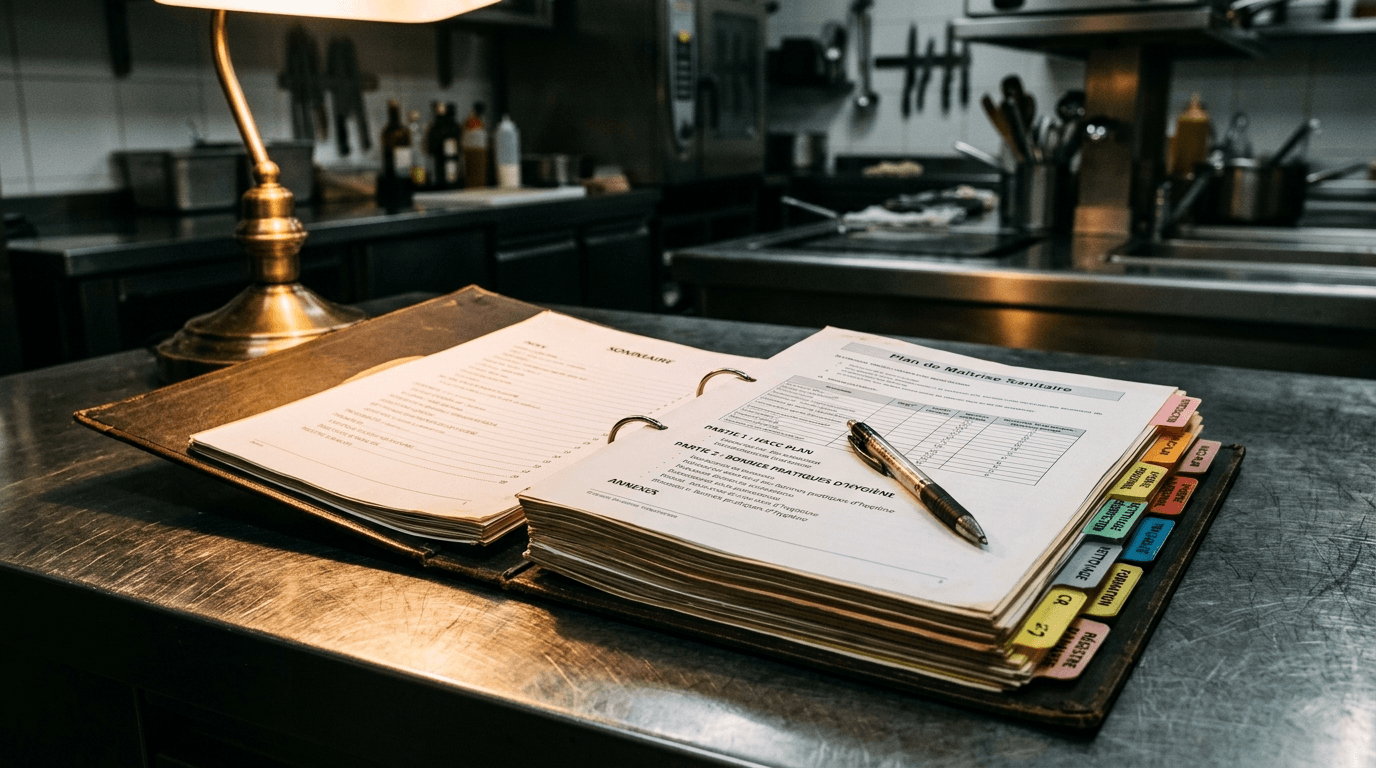
Restaurant FSMS: the mandatory documentation pack that proves to the EHO/FSA your business controls food safety risk at every step of the food chain.
Is the FSMS really mandatory in restaurants?
Yes. No exceptions. Under EU Reg 852/2004 and the UK Food Hygiene Regulations 2013, every commercial food service business has to have a written, applicable, current FSMS. Not a recommendation — a legal obligation.
When the inspector visits, they ask for your FSMS in the first few minutes. Can't produce it, or it's clearly out of date — you're looking at an immediate improvement notice. Consequences run from warning to emergency closure depending on severity.
What EU Reg 852/2004 actually requires
EU Regulation 852/2004 is the legal foundation — kept by the UK post-Brexit through retained legislation. It requires food business operators to put in place, apply and maintain permanent procedures based on HACCP principles. The FSMS is the documentary translation of that obligation. It has to cover everything you do: receiving, storage, prep, cooking, service, cleaning.
What does a restaurant FSMS contain?
A complete FSMS is built on 6 mandatory documents. Each one covers a specific risk category.
The 6 FSMS documents
- Good Hygiene Practices (GHP) — staff hygiene, uniforms, hand washing, illness reporting
- HACCP plan — identification of Critical Control Points (CCPs), safety limits, corrective actions. See detailed HACCP principles to build this part
- Cleaning and disinfection procedures — cleaning schedule, frequencies, products used, traceability of who did what
- Water and waste management — process water quality, sorting, collection frequency
- Team training and supervision — food safety training certificates, training plan, qualifications
- Pest control plan — pest control contract, visit frequency, intervention sheets
Always start with GHP and the HACCP plan. Those are the first two documents the inspector pulls. The other 4 follow naturally once the foundations are there.
How do you keep an FSMS current without giving up your evenings?
This is where everyone fails. Building the FSMS once is fine. Keeping it current over 3 years is a different game.
A living FSMS means tracking:
- Storage temperatures (walk-ins, hot holding) — ideally daily
- Non-conformities spotted and the corrective actions you took
- Training for each team member with date and certificate
- Pest control visits with signed report
- Recipe cards and especially allergens in your FSMS — mandatory under EU 1169/2011 (kept by UK post-Brexit)
Done manually, all of that takes around 30 minutes a day for a standard operation. Doesn't sound like much. Over a year that's 180 hours. And when you're in the middle of service, those 30 minutes get skipped. And again the next day. Three weeks later, your FSMS doesn't reflect anything real.
With software automating traceability, you drop to 0 minutes of manual entry on the records side. Temperatures get logged via probes or 10-second guided entries. Non-conformity alerts are automatic.
Case study — La Verrerie vs Lunch Wagon
Two concrete pictures, both mine.
La Verrerie, Gaillac, 2017. Hotel-restaurant, 14 rooms, in the middle of a court-supervised turnaround. I find out an inspection is scheduled for the next morning. My FSMS: a printed Excel folder, half-updated for the last 4 months. That night I spent 6 hours on it. Reconstructing missing temperature logs, finding lost training certificates, checking that the cleaning schedule matched what we actually do in the kitchen. Six hours until 2am, before the next day's service. The kind of night you don't forget.
The inspection went fine, but for the wrong reasons: I'd patched it just enough to pass. That's not how you pass an EHO/FSA inspection cleanly.
Lunch Wagon, Albi, 2024. Burger food truck, taken over in court-supervised turnaround. Same kind of inspection, told the day before. Time spent prepping the FSMS: 0 minutes. Why? Because the records had been logged in real time from day one. Fridge temperatures, cleaning, team training — all documented as it happened. I opened the tool, showed the history. The inspector checked. We passed.
The difference between those two situations? Not the level of hygiene. Not the size of the operation. Just the traceability method — manual vs automated.
Paper FSMS vs software: what actually changes
| Criterion | Paper / Excel FSMS | FSMS with software |
|---|---|---|
| Initial setup | Fast (1-2 days) | Guided (a few hours) |
| Daily entry time | 20-30 min/day | 0-5 min/day |
| Risk of skipped traceability | High | Low (automatic alerts) |
| Inspection prep time | 3-6h of panic | 0h — already there |
| Allergen management | Manual, error-prone | Built into the recipe cards |
| FIFO stock control | Separate, not linked to FSMS | Coupled — see FIFO stock control for HACCP |
| Cost | Low (paper + human time) | Monthly subscription |
The apparent paper cost is misleading. 30 minutes a day at £18/hour of labour is £3,300/year of wasted time. Not counting the catch-up nights before inspection.
Common FSMS mistakes
Building an FSMS "for the inspection" and never applying it day to day: most common mistake. The inspector spots it instantly — an FSMS without regular records is an FSMS that doesn't exist in practice.
- Copy-pasting a generic template without adapting it to your operation, your menu, your team. The FSMS has to describe WHAT YOU DO, not what a textbook restaurant should be doing in theory.
- Not updating the FSMS when the menu changes. Every new dish means revisiting the CCPs and the linked recipe cards. The allergens in your FSMS need updating every time a recipe changes.
- Skipping training records. Training your team without keeping certificates is the same as not training them, in the inspector's eyes.
- No non-conformities recorded. An FSMS with zero non-conformities ever is suspicious. It implies you've never had a fridge break down, never refused a delivery. The inspector doesn't believe it.
Conclusion
Three things to remember about the restaurant FSMS in 2026:
- It's mandatory and non-negotiable. No FSMS or untouched FSMS = improvement notice. No flexibility there.
- Content matters, but daily traceability matters more. A pretty static document that doesn't match your reality doesn't protect you on inspection.
- The manual method doesn't survive over time. 30 min/day × 365 = a full day per week lost on data entry. Software gives that time back to your kitchen.
I lost 6 hours in one night at La Verrerie reconstructing an FSMS I should have been keeping current for months. At the Lunch Wagon I never thought about it because it was logged automatically. The difference between those two nights is the tool.
The order you make decisions in beats the decisions themselves. Build the system once, then the system runs itself.
Tu veux voir comment Onrush gère ça sur ton restaurant ?
Démo 20 min, sans engagement. On regarde tes vrais chiffres.
Demander une démo →Articles liés
Best HACCP software 2026: comparison + criteria (top 5)
2026 comparison of restaurant HACCP software: temperature logs, food safety management, mobile, EHO alerts. Top 5 reviewed.
HACCP for restaurants: the complete 2026 guide (method + FSMS + software)
HACCP: principles, the 7-step method, food safety management system, temperatures, traceability. Pass an EHO/FSA inspection without sweating in 2026.
EHO / FSA restaurant inspection: passing your check without stress (2026)
EHO/FSA inspection: how it runs, documents asked for, typical questions, penalties, 15-day prep checklist.
Best food cost software 2026: comparison + selection criteria
2026 comparison of restaurant food cost software: price cascade, theoretical/actual, POS integrations. Top 5 reviewed.
Last updated 2026. Written by Cyril Quesnel, founder of Onrush, ex-cook (La Verrerie 2015-2018, Lunch Wagon 2023-2026).