Restaurant food waste: identify and reduce in 2026
Food waste: typology (breakage, expiry, over-portioning, theft), measurement method, reduction levers.
In short. Food waste runs at 3 to 8% of food cost in a restaurant. It splits into 4 families: breakage, expiry, over-portioning and theft. Identifying it through weighing and tracking the variance between theoretical and real food cost is the fastest lever to claw back margin points without touching the menu.
Context / Definition
Restaurant food waste is everything you buy that doesn't end up on a paying plate. That includes trim, expired stock, portion errors and unexplained shrinkage. It's silent, it's regular, and it's often the least-tracked waste category — yet its direct impact on food cost is immediate.
Food waste: the gap between the quantity of goods bought and the quantity actually sold on plates, expressed as a percentage of food cost or in absolute monetary value.
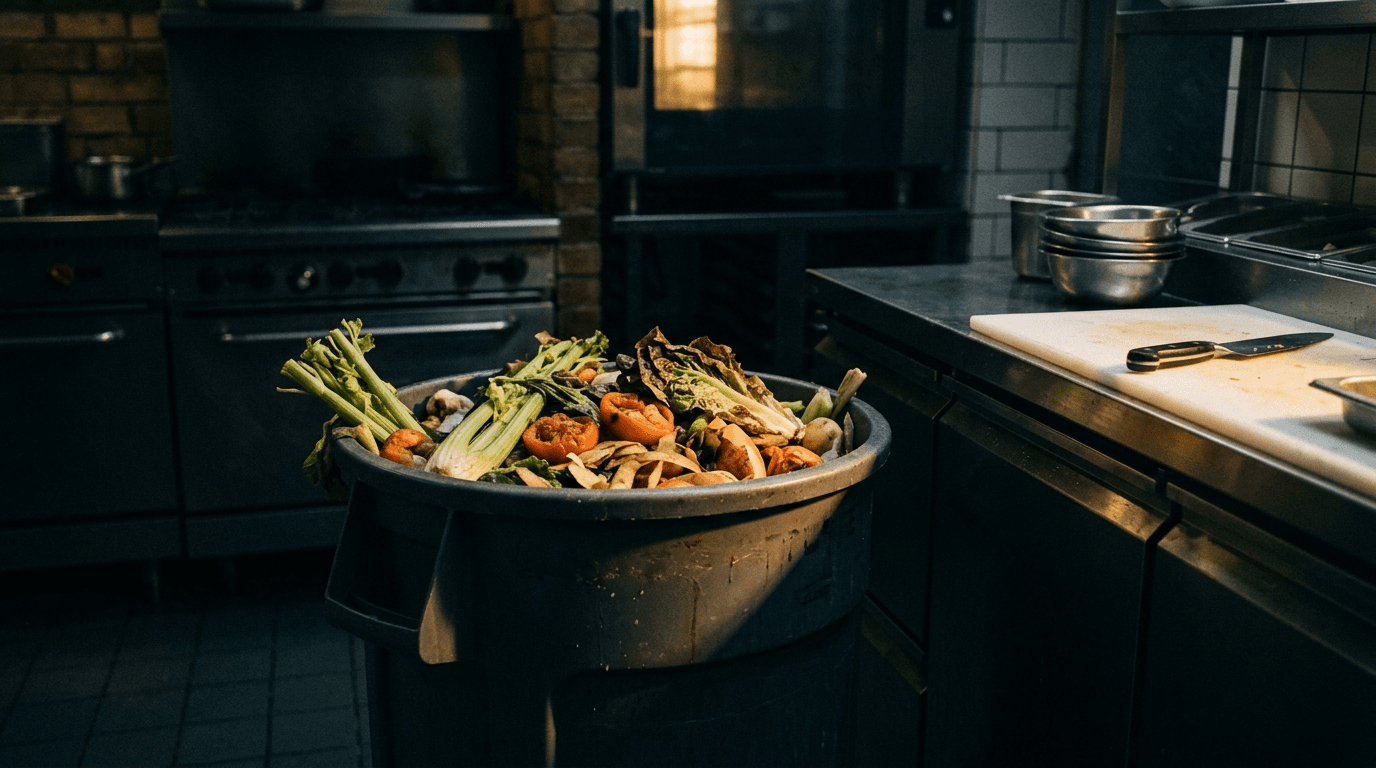
What are the 4 families of food waste?
The first mistake is dumping it all in one bag called "waste". In reality, each family has its own cause, fix and owner. Confusing them means correcting blind.
1. Breakage and trim
Trimming — trimming a cut of meat, peeling veg, filleting fish — generates unavoidable losses. But "unavoidable" doesn't mean "unmeasurable". A flank steak loses 8 to 12% on average to trimming, depending on supplier quality and cook technique. Note the loss rate of every product in your recipe cards and accurate weights. Without that benchmark, you don't know if your cook trims well or badly.
2. Expiry
20% of losses in the 0-3°C zone are tied to expiry in an average restaurant in 2026. That number climbs when orders aren't based on real sales. An expired product is 100% of its value lost — no recovery. Main cause: over-generous orders "just in case" plus storage that puts new stock in front of old.
3. Over-portioning
The most insidious loss. Nobody catches it in real time. The cook plates 220g instead of 200g, because "it looks better on the plate" or because there's no scale within reach. Multiply by 40 covers and 300 days and the numbers hurt — we'll come back to that in the case study.
4. Theft and unrecorded items
Staff meals not logged, kitchen tasting, till errors, comps not tracked. Not always malicious, but always a real loss. In serious management, staff meals are costed and folded into theoretical food cost. Comps too.
How do you measure food waste?
Two complementary methods. Ideally, run both.
- The food cost variance method: compute your theoretical food cost (what you should have consumed based on sales and recipe cards) and your real food cost (what you actually ordered and consumed). The variance is your waste.
- Bin weighing: weigh bins by category (raw, cooked, non-conforming) for one test week. Tedious, but it pinpoints exactly where it leaks.
- Regular stocktake: a stocktake at the right frequency is essential to make the two methods above reliable.
- Per-product tracking: some products deserve individual tracking — premium meats, fish, spirits. Weigh on receipt, log on outbound, calculate the real loss rate.
Start with the food cost variance method over 4 weeks before going further. If the variance exceeds 2 food cost points, you have a concrete problem to investigate. Quick to set up and it immediately points to the action.
Case study — La Verrerie, 2016
In 2016, at La Verrerie in Gaillac, we had a classic problem: the flank steak was selling well, customers were happy, the cook was doing solid work. Everything looked fine on the surface.
Except I'd looked at the numbers closely. The recipe portion was 180g. Actual portion weighed over a week was 198g on average. 18 grams of variance. Sounds like nothing.
Except across 40 covers a day, 300 days a year, that's 216 kg of flank steak going to the dining room without being charged. At £22/kg purchase price at the time, that's £4,750 walking out the door each year on a single dish, purely from lack of portion discipline. No bad faith. No theft. Just no scale within reach of the station and a recipe card that wasn't being followed.
The fix was simple: a fixed scale on the cold station, a reminder at brigade meeting, a note on the recipe card. Two weeks later the variance was back to 3g. That kind of adjustment is the difference between a margin that holds and a margin that bleeds.
Waste by establishment type
| Establishment type | Normal food waste | Alert threshold | Main cause |
|---|---|---|---|
| Bistro / casual dining | 3–5% | > 6% | Over-portioning, expiry |
| Fine dining | 5–8% | > 10% | Heavy technical trimming |
| Food truck | 2–4% | > 5% | Tight menu, high rotation |
| Quick service | 2–4% | > 5% | Strong standardisation |
| Sandwich / snack | 1–3% | > 4% | Few premium fresh products |
These are 2026 benchmarks, cross-checked with available sector data. Your operation has its own settings — a long menu with premium product mechanically pulls the number up.
Common mistakes on food waste
Failing to separate avoidable from structural losses. The trim rate on a premium cut is unavoidable — the problem is when it drifts without anyone measuring.
- Counting only visible waste. Over-portioning goes through the till and never hits the bin. Invisible if you don't weigh.
- Trusting that the cook "knows" the right portion. Without a scale at the station and a respected recipe card, even the best cook drifts 10 to 20g per plate.
- Ignoring FEFO. First Expired, First Out. If you store new deliveries in front of old ones — because it's faster — you mechanically generate expiry losses.
- Stocktaking only once a month. Once a month, you observe. Once a week on premium products, you control. See optimal stocktake frequency by establishment type.
- Costing staff meals at zero. If you don't count them, they inflate your real food cost without explanation. They have to feature in theoretical food cost at purchase price.
Conclusion
Restaurant food waste isn't a fate. It has 4 families — breakage, expiry, over-portioning, theft — and each has its remedy.
Three things to keep. First, over-portioning is the most underestimated lever: invisible to the eye, it can mean several thousand pounds a year on a single product. Second, measuring is already acting — a weekly track of the variance between theoretical and real food cost tells you where to look. Third, overall restaurant profitability is built on small, repeated adjustments — not on grand annual reforms.
18 grams of flank steak per plate. £4,750 a year. That's where it starts.
Si t'as aimé cet article, lis celui-ci ensuite :
→ Cut your food cost: 7 concrete levers (2026 Guide)↗Articles liés
Restaurant stocktake: how often and how (2026)
Restaurant stocktake: optimal frequency, fast method, costing, tools. From 4-hour monthly to 20-minute weekly.
Restaurant stock management: complete guide 2026 (FIFO, stocktake, food waste)
Stock management: FIFO/FEFO method, stocktake frequency, costing, food waste. Software vs spreadsheet.
Cut your food cost: 7 concrete levers (2026 Guide)
Food cost at 32%? 7 levers you can pull this week to gain 3 to 5 points of margin. Field-tested method across 2 restaurants.
Restaurant menu engineering: optimising your menu profitability (2026)
Menu engineering: popularity × margin matrix, stars vs dogs, repositioning method. Add 3 to 7% revenue.
Last updated 2026. Written by Cyril Quesnel, founder of Onrush, chef-entrepreneur (La Verrerie 2015-2018, Lunch Wagon 2023-2026).