Food recall restaurant: handling product recalls in 2026
FSA food recalls: alerts, restaurant duties, recall procedure, software that auto-alerts. UK retained law explained.
In short. The FSA recall feed (food.gov.uk) is the official UK source for food alerts. As an operator, you have a duty to immediately withdraw any recalled product, inform customers within 72 hours if you suspect they consumed it, and trace every lot. Hundreds of recalls go out each year. Without an automatic alert system, you miss them. And it can cost you — UK fines start at £5,000 for serious cases under the Food Safety Act 1990, unlimited for category 1 offences.
Context / Definition
The FSA recall feed (food.gov.uk) is the official UK platform that centralises all food alerts placed on the market — food, supplements, allergen mislabelling. For a restaurant operator, it's the source you have to monitor constantly: if a product you have in stock gets recalled, you have to act now. New lots are flagged every week. Every week, operators miss them because they have no monitoring system.
FSA recall feed: a public platform (food.gov.uk) listing in real time the product recalls reported by manufacturers and distributors, accessible via an open feed for professionals and developers. The EU equivalent (RASFF) feeds into it for cross-border products.
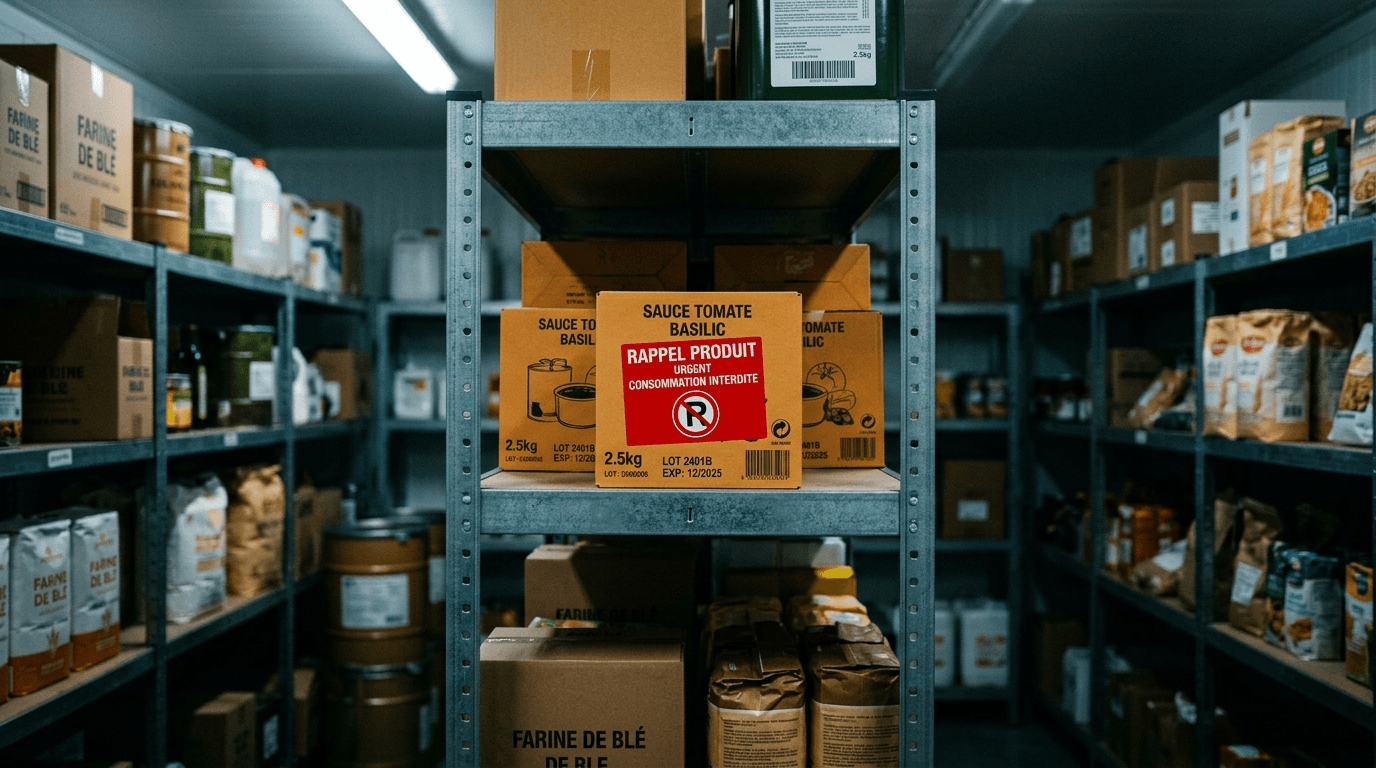
Food recalls: what does it actually mean for a restaurant?
You have three legal duties when a recall hits your business.
Duty one: pull the product immediately. The moment you spot a recalled lot in your stock, the product comes out of the kitchen. You don't serve it, you don't wait for further confirmation. EU Regulation 178/2002 on food safety (UK retained law) is unambiguous on this.
Duty two: inform your customers within 72 hours if you have reason to believe they already consumed the recalled product. A notice in the dining room, a post on your social, a phone call if you have the contacts. No need to publicly panic, but silence isn't an option.
Duty three: trace. Which lot, which supplier, which delivery date, which dish. If the EHO turns up after an incident, you need to be able to rebuild the full chain. See our breakdown of full legal obligations for the entire regulatory frame.
What the rules say
Regulation 852/2004 (UK retained) and Regulation 178/2002 set the frame. The FSA runs the alert system in the UK, with feeds at food.gov.uk and operator self-reporting duties built in. As a restaurant, you're at the end of the chain — you're the one who has to monitor.
How do I get auto-alerts on product recalls?
There are two ways to get alerted. The DIY method. And the one that actually works.
DIY method: you check food.gov.uk regularly, browse the food categories, hope you didn't miss an alert. Realistic? No. Nobody actually does this, especially not between two services.
The one that works: restaurant software with FSA recall feed integration. The public API/RSS lets you query the database in real time. A cron every hour, a push alert on your phone if a product in your category gets recalled. That's what Onrush does natively.
Steps to set up effective monitoring:
- Identify your suppliers and high-risk categories — cured meats, dairy, meats, ready-prepared veg are the most affected statistically
- Pick an automatic alert system — software with built-in API or RSS subscription to the FSA feed
- Define a handling protocol — who receives the alert, who pulls, who traces, who informs if needed
- Document every action — timestamp, lot, quantity withdrawn, destination (bin, supplier return)
Set your alert on broad categories, not just brands you know. A supplier can change packaging or sub-brand between two orders. Category-based monitoring is safer than brand-based.
The topic ties directly into your HACCP and traceability — a solid food safety management system has the recall protocol built in from day one.
Real case — The listeria recall I would have missed
Late 2024, listeria recall on a sliced cured-meat reference. Alert published on a Thursday morning. The lot in question had a use-by date at the end of the week, so it was sitting in active stock in dozens of kitchens.
Without an automatic system, the realistic scenario is this: the alert drops during the lunch rush, nobody checks the FSA feed, the product ends up on plates that evening. You discover the alert on Monday while doing something else. Too late.
With restaurant software polling the feed every hour, the alert lands on the chef's phone at 9:15 that Thursday. Cross-check the delivery note, identify the lot in stock, immediate withdrawal, log it in the HACCP records. All before lunch service even starts.
The difference between the two scenarios isn't the operator's intent. It's the existence or absence of a system. The FSMS and incident handling — that's exactly that difference, turned into a system.
Recall monitoring methods: comparison table
| Method | Speed | Reliability | Effort | Cost |
|---|---|---|---|---|
| Manual website checks | Low — depends on you | Very low | High | £0 |
| FSA RSS feed | Medium — manual reading | Medium | Medium | £0 |
| FSA email alerts | Medium — possible delay | Good | Low | £0 |
| Software API (hourly cron) | High — automatic | Very good | None | Included in subscription |
| Software with push notifications | High — instant alert | Very good | None | Included in subscription |
The takeaway is simple: only an API integration in your software gives you real monitoring. Everything else relies on your discipline at a moment when you have other things to do. And in a restaurant, there's always something else to do.
Stock management and lot traceability is the natural counterpart to this monitoring: if you don't know which lot you have in stock, the recall alert is useless.
Common mistakes when a recall hits
Failing to log the withdrawal is a costly mistake during an EHO inspection. The officer doesn't ask if you withdrew the product — they ask for proof you did. Without a timestamped document, you've got nothing.
- Waiting for supplier confirmation before withdrawing. You don't wait. The FSA alert is enough. The supplier will refund you afterwards — that's their problem, not yours.
- Only pulling visible stock. Think of pre-prepared products (terrines, stuffings, ready meals) that include the recalled reference.
- Believing a small lot means less risk. Liability doesn't depend on quantity. A 1 kg lot not withdrawn carries the same liability as 100 kg.
- Not informing customers. If you served the recalled product and customers are identifiable (bookings, card receipts), you must contact them. Not optional.
- Disposing without documenting. Date, lot, supplier, quantity, reason, action taken. Five lines that can save you from prosecution.
To understand what an inspection looks like and what the EHO actually checks, see EHO inspection and recalls.
Conclusion
Three things to remember.
One. FSA recalls aren't a recommendation, they're a duty. Immediate withdrawal, customer information within 72 hours if needed, lot traceability. No room for interpretation.
Two. Manual monitoring doesn't work in practice. The only reliable system is automatic API integration in your management software. Everything else relies on a discipline nobody really has day-to-day in a kitchen.
Three. Lot traceability is the link that holds everything else together. If you don't know which lot you have in stock and since when, the recall alert can't protect you. It's a complete system, or it's not much.
Si t'as aimé cet article, lis celui-ci ensuite :
→ Best HACCP software 2026: comparison + criteria (top 5)↗Articles liés
Best HACCP software 2026: comparison + criteria (top 5)
2026 comparison of restaurant HACCP software: temperature logs, food safety management, mobile, EHO alerts. Top 5 reviewed.
Restaurant legal obligations 2026: the complete guide (hygiene + FIC + tax)
Restaurant legal obligations 2026: HACCP, allergens, price display, receipts, HMRC, VAT. Compliance checklist.
HACCP temperatures restaurant 2026: the standards (+ logs)
HACCP temperatures restaurant: 2026 standards, cold/hot thresholds, log frequency, penalties. Field-tested method.
Restaurant FSMS: your Food Safety Management System in 2026 (template + software)
Food Safety Management System: required content, downloadable template, the method to keep it current without giving up your evenings.
Last updated 21 April 2026. Written by Cyril Quesnel, founder of Onrush, chef and entrepreneur (La Verrerie 2015-2018, Lunch Wagon 2023-2026).