Food cost in restaurants: the complete 2026 guide (calculation, levers, software)
Food cost: definition, theoretical vs actual calculation, target ratios by restaurant type, 7 levers to bring it down. Field method + free tool.
The short version. Food cost is the slice of your revenue that goes into raw ingredients. Target: 28-32% in a classic bistro. Problem: most operators discover the number in the year-end P&L — when it is already too late to fix. This guide shows you how to calculate it, where the money leaks without you seeing, and how to manage it day to day.
Context / Definition
Food cost is the ratio between the cost of your raw materials and your turnover. It is one of the two indicators that decide whether your restaurant is viable — together with labour cost. Combined, they often eat 60 to 70% of revenue. What is left is your gross margin. Out of that you pay rent, fixed costs, and if you are lucky, you pay yourself.
Food cost: a ratio expressed as a percentage equal to (total cost of raw materials consumed ÷ net sales) × 100. It measures how much you spend on ingredients to generate £1 of sales.
Most chefs know the term. Few actually manage it. Even fewer measure it in real time. That is what this guide is for.
What is a good food cost in a restaurant?
Direct answer: it depends on your concept. But there are reference ranges the industry has validated for decades.
The problem is that many operators aim "around 30%" without ever checking they are actually there. And 2 or 3 points off on £800,000 of turnover is £24,000 of margin lost per year. Not a rounding error.
Target ratios by restaurant type (2026)
| Restaurant type | Target food cost | Comment |
|---|---|---|
| Classic bistro / brasserie | 28–32% | Fresh produce, high turnover |
| Fine dining / bistronomy | 25–30% | Premium ingredients, tight recipe cards mandatory |
| Pizza / pasta | 30–35% | Cheap ingredients, volume offsets margin |
| Fast-casual / burger | 28–33% | Margin offset by throughput |
| Sandwich / quick service | 22–28% | Low ingredient cost, high margin |
| Food truck | 28–34% | Limited waste if managed, but small-quantity buying = higher unit cost |
These numbers are not gospel. They are anchors. If you are at 36% in a bistro, you have a problem. If you are at 26% in fine dining, you either have exceptional suppliers or your portions are too small. Either way, you need to understand why.
What matters is knowing where you stand today — not in 6 months at the year-end accounts.
How do you calculate the food cost of a dish?
Base formula: (raw food cost × waste coefficient) ÷ net selling price × 100.
Two distinct calculations exist. Theoretical food cost — what you compute on paper from your recipe cards. And actual food cost — what you measure with your inventories and effective purchases. Both are useful. The gap between them, even more so.
Food cost of a dish — worked example
Take a steak frites sold at £18 net.
- Beef cut (200g raw, 15% waste) → net cost = £3.20 × 1.15 = £3.68
- Potatoes (300g raw, 20% waste) → £0.60 × 1.20 = £0.72
- Butter, salt, condiments → £0.35
- Total ingredient cost: £4.75
Theoretical food cost = (4.75 ÷ 18) × 100 = 26.4%
You are on target for a bistro. But does your cook actually weigh 200g of beef every service? Are you buying the same beef at the same price as 3 months ago? That is where theoretical and actual diverge.
For precise food cost calculation per dish, you need rigorous recipe cards — net grammage, product-specific waste coefficients, and supplier prices kept current. Not prices from a year ago.
Actual food cost — the inventory formula
Actual food cost = (Opening stock + Purchases for the period − Closing stock) ÷ Net sales × 100
This is the only number that tells you what really happened in your kitchen. It captures waste, portioning errors, shrinkage, staff meals, and everything that did not leave on a sold plate.
The gap between theoretical and actual food cost is your leak gauge. 3 points of gap on £800,000 turnover = £24,000 of margin disappearing every year. Most operators never measure it.
Theoretical vs actual food cost: understanding the gap
Theoretical food cost is your perfect kitchen on paper. Actual is your kitchen the way it really runs. The average gap in independent restaurants sits around 3 points. In poorly managed places, it tops 6 or 7.
Where does the gap come from?
- Involuntary over-portioning. Your cook plates 240g of beef instead of 200g. Without systematic weighing, impossible to detect.
- Unaccounted waste. Vegetables damaged at delivery, poorly optimised cuts, products expired before use.
- Shrinkage. Unrecorded staff consumption, small thefts, free meals to friends.
- Supplier prices not updated in the cards. You are calculating theoretical food cost with January prices. It is June. Beef is up 8%.
- Recipe not respected. Staff turnover, new hires, busy service: grammage drifts.
That is why recipe cards kept up to date automatically are not a fine-dining luxury. They are the foundation of management.
The 7 levers to cut your food cost
Reducing food cost does not mean reducing quality. It means plugging the leaks. Here are the 7 operational levers, in order of impact.
1. Update your supplier price list every week
The price of beef, salmon, olive oil moves. If your recipe cards are still running on the price you negotiated last quarter, your theoretical food cost is wrong. And you are making menu decisions on wrong numbers.
A live supplier price list lets you know instantly when an item costs you 15% more than two months ago. And adjust — selling price, portion, or substitution.
2. Weigh systematically in production
Put a scale on the pass and weigh portions before they go out. Not to police your team — to set a real baseline. In 3 weeks, you know whether your portions match your cards. Often, they drift by 10 to 15%.
3. Optimise your supplier orders
Too much stock = waste. Too little = emergency buying at full price. The right level is ordering just enough. That requires reliable sales history and a tight stock view. On paper, trivial. In a kitchen at 6am, another story.
4. Rework your menu engineering
Some dishes drive volume but kill your margins. Others are profitable but rarely ordered. Menu engineering — crossing food cost with popularity — lets you decide what to keep, what to tweak, what to drop. To cut your food cost in concrete steps, this is often where the fastest gain hides.
5. Track losses at goods-in
A box of lettuce arriving with 20% damaged = your actual food cost climbing without you noticing. Checking deliveries, logging anomalies, having return clauses with your suppliers: that is cash recovered directly.
6. Standardise recipes and train continuously
One dish, one recipe, one grammage. Not "roughly". If you run with extras or a new team every season, standardisation is the only way to keep consistency. A printed recipe card visible in the kitchen beats a recipe in the head chef's memory.
7. Measure food cost monthly — and aim for daily
Monthly inventory is the floor. But it is still a snapshot taken too late. Food cost calculated in real time — at every supplier price change, at every recipe edit — is what lets you act before things drift, not after.
Case study — La Verrerie, Gaillac, 2016
In 2016, I got the surprise I should have seen coming.
La Verrerie was running well. We were ramping up. Service was good, reviews climbing. Then the year-end accounts landed. My accountant told me actual food cost over the year was 36%. My target was 28%. So I had lost 8 points of margin across the whole year.
On around £400,000 of turnover at the time, that was £32,000 of margin evaporated in a year. Without me seeing a thing.
How was that possible? I had recipe cards. I ordered properly. But my supplier prices had not been updated since opening. My cooks were portioning without weighing. And I had spent 6 months doing emergency orders myself after my head chef left — at unnegotiated prices, often in small quantities.
Result: my theoretical food cost was at 29%. My actual was 36%. 7-point gap. On £800,000 turnover the following year, that would have been £56,000 of margin lost.
The lesson? The year-end accounts are a post-mortem. By the time you read them, the money is gone. What you need is at minimum a monthly indicator — and ideally a tool that recalculates automatically every time a supplier price changes.
That experience is exactly what sits at the core of Onrush. Not a gimmick dashboard. A tool that stops you discovering this kind of surprise in the P&L.
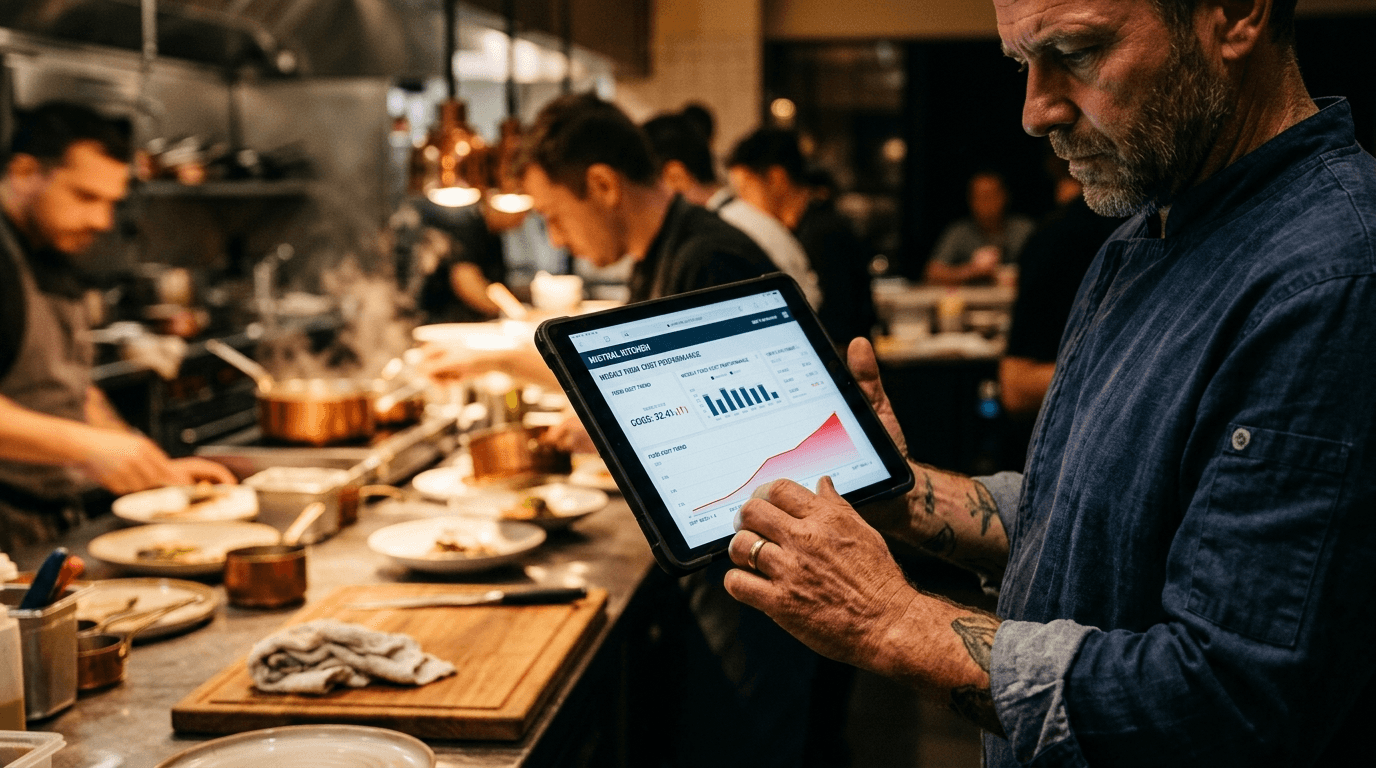
Managing food cost: year-end accounts, spreadsheet or real time?
Three practices coexist in 2026. They do not produce the same decisions.
- Frequency
- Once a year
- Diagnosis lag
- 3 to 14 months
- Action possible
- Too late — money already gone
- Theoretical/actual gap
- Never measured
- Frequency
- Once a month
- Diagnosis lag
- 30 to 45 days
- Action possible
- Correct the following month
- Theoretical/actual gap
- Measured, but with delay
- Frequency
- Every price change
- Diagnosis lag
- Instant
- Action possible
- Before the next service
- Theoretical/actual gap
- Visible continuously
The real question to ask any software: is the food cost of all my dishes recalculated automatically the moment a supplier price changes?
If the answer is "no" or "you have to do it manually", that is not management. That is disguised bookkeeping.
To compare food cost software on the market, that criteria grid is the right starting point. With one absolute priority: mobile usage, in real time, by someone in the weeds at 10am.
The core principle of Onrush is simple: you take a photo of your supplier invoice. The OCR reads the items and prices. Every recipe card affected is recalculated automatically. Your food cost is up to date. The whole gesture takes 30 seconds.
To run profitability day by day, that level of granularity is what separates being subjected to your margin from steering it.
Common food cost mistakes
Confusing "low food cost" with "profitability" — a 22% food cost on tiny portions generates bad reviews and kills repeat customers. Margin is managed across the whole P&L, not on a single indicator.
- Calculating food cost once a year in the P&L. The money has been gone a long time. A monthly inventory is the absolute minimum.
- Not building waste into theoretical food cost. A 0% waste coefficient on beef does not exist. Every product has its real-world reality — vegetables 10-25%, fish 20-40%, meat 10-20%.
- Using stale supplier prices in your recipe cards. If your supplier price list is not current, your theoretical food cost is fiction.
- Ignoring the theoretical/actual gap. Many chefs calculate theoretical food cost and stop there. The monthly inventory that gives the actual figure — 80% of operators do not do it systematically.
- Not training the team on grammage. A recipe in the head chef's memory does not survive a brigade of 4 in full service. Recipe cards visible in the kitchen are non-negotiable.
- Thinking dish by dish without looking at the mix. A dish at 20% food cost ordered by 5% of customers does not have the same impact as a dish at 34% ordered by 40%.
Conclusion
Three things to take from this guide.
First: food cost is not managed in the year-end accounts. It is a living number that moves with every supplier price change, every portion variation, every untracked loss. Discovering it once a year is driving while looking in the rear-view mirror.
Second: the gap between theoretical and actual is your real gauge. Theoretical at 29% with actual at 36% is 7 points of margin disappearing silently. On £800,000 turnover, that is £56,000 a year. Not an accounting anomaly. An operational leak.
Third: structure makes the difference. Up-to-date recipe cards, live supplier price list, monthly inventory minimum, grammage training. Not bureaucratic constraints. The line between a restaurant that endures its margins and one that steers them.
The number does not make profit. But a managed food cost does.
Si t'as aimé cet article, lis celui-ci ensuite :
→ Best food cost software 2026: comparison + selection criteria↗Articles liés
Best food cost software 2026: comparison + selection criteria
2026 comparison of restaurant food cost software: price cascade, theoretical/actual, POS integrations. Top 5 reviewed.
Food cost: how to calculate it precisely (formula + worked example)
Theoretical food cost formula, actual food cost, food cost per dish. Worked numbers + free worksheet.
Restaurant menu engineering: optimising your menu profitability (2026)
Menu engineering: popularity × margin matrix, stars vs dogs, repositioning method. Add 3 to 7% revenue.
Restaurant KPIs: the essential 2026 dashboard (12 indicators)
The 12 KPIs to track in a restaurant: food cost, labour ratio, average check, revenue per sqm. Sample dashboard + frequency.
Last updated 21 April 2026. Written by Cyril Quesnel, founder of Onrush, chef and operator (La Verrerie 2015–2018, Lunch Wagon 2023–2026).