Food cost: how to calculate it precisely (formula + worked example)
Theoretical food cost formula, actual food cost, food cost per dish. Worked numbers + free worksheet.
The short version. Food cost is calculated by dividing real ingredient cost by net selling price, multiplied by 100. But 90% of operators run the calculation with the wrong inputs — and end up with a 4 to 6 point gap between their theoretical figure and reality. This page gives you the exact formula, per-dish calculation, and the mistakes that throw it all off.
Context / Definition
Restaurant food cost calculation is the most important management act a chef-owner can do. And paradoxically, it is the one most of them get wrong. Not because they cannot do maths. Because they were taught a simplified version that leaves 3 to 6 points of margin on the side of the road.
Food cost: a ratio expressing the cost of raw materials as a percentage of net sales. It is calculated at two levels — theoretical (from recipe cards) and actual (from inventory).
For more on target ratios by restaurant type, see the guide food cost: definition and target ratios.
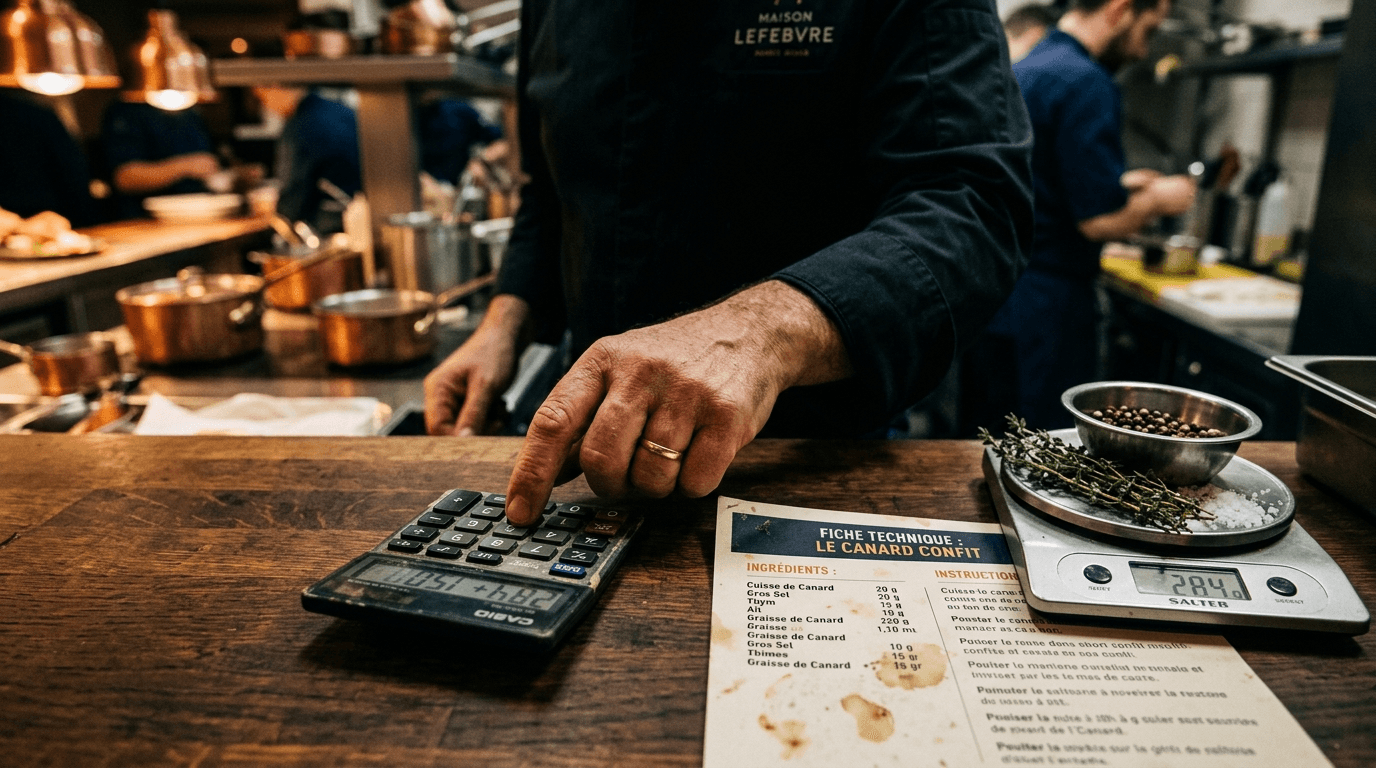
The food cost formula: how it really works
The base formula everyone knows:
Food cost (%) = Net ingredient cost ÷ Net selling price × 100
That is correct. But incomplete. This formula gives you the theoretical food cost of a dish — the one that comes clean off your recipe card, in a world where every gram of ingredient becomes plate sold.
Problem is, that world does not exist in a kitchen.
The complete formula — with waste built in
Actual food cost (%) = (Ingredient cost × (1 + % waste)) ÷ Net selling price × 100
The waste coefficient runs between 3% and 8% depending on the product:
- Peeled vegetables: 5 to 8%
- Boned meat: 4 to 6%
- Ready-to-use products: 1 to 3%
5% of unaccounted waste on a dish with £3 of ingredient cost = 1.5 points of food cost gone from your analysis. Multiply by 40 dishes a day, and that is a line missing from your bottom line.
The markup multiplier: the other side of the calculation
The markup multiplier is the inverse of food cost expressed as a decimal.
Multiplier = 1 ÷ (target food cost / 100)
For a 28% target food cost: multiplier = 1 ÷ 0.28 = 3.57
You multiply your ingredient cost by that figure to get your minimum net selling price. It is a quick tool to build menu pricing. But careful — it does not account for waste if you have not built it into the ingredient cost upstream.
How to calculate food cost per dish (step by step)
Here is the concrete method. Not the catering-school theoretical method. The one I actually use.
- List every ingredient in the dish — every component, including sauces, sides and free accompaniments
- Weigh net quantities (after peeling, trimming, cooking if cook loss applies)
- Apply the unit purchase price from your current supplier price list
- Add the waste coefficient depending on product nature (3 to 8%)
- Add packaging if you do takeaway (tray, film, bag)
- Divide by the net selling price
Only once these 6 steps are done do you get a per-dish food cost you can actually use to make decisions.
Start with your 5 best-selling dishes. Not the whole menu. If you spot an anomaly on those 5, you fix what weighs heaviest in your turnover first.
To build recipe cards without errors that integrate these elements correctly from day one, you need a method — and a bit of discipline in the first weeks.
Case study — Lunch Wagon, 2024
In 2024, Lunch Wagon was running a 28% food cost. That is what came out of the recipe cards. That is what I told suppliers when negotiating terms.
Except at inventory, recalculating actual, we were at 33%.
5 points off. On a food truck doing £200,000 annual turnover, that is £10,000 of ingredients walking out without us knowing where.
We dug. Three causes:
First: the waste coefficient was not built into the cards. Burgers were priced on 180g of net beef. In reality, between handling, grill loss and the heat lamp, we routinely lost 8 to 10g per piece. Nothing dramatic per piece. Multiplied by 80 covers a day across 200 days, that is over 10kg of unaccounted beef.
Second: packaging was not in food cost. Tray, napkin, bag — between £0.18 and £0.22 per order. On 60 orders a day, that is £11 to £13 per service that did not exist anywhere in the calculation.
Third: complimentary bites. At certain events, we offered fries as openers for atmosphere. Never tracked. Because "it is free, it does not go in food cost". It does. Anything that leaves your kitchen goes in food cost.
After that diagnosis, we built waste + packaging into every card. Actual food cost dropped back to 29.5% — without changing prices, without changing suppliers. Just by identifying hidden ingredient losses and putting them into the calculation.
Comparison table — Theoretical vs actual food cost
| Criterion | Theoretical food cost | Actual food cost |
|---|---|---|
| Calculation base | Recipe cards | Period inventory |
| Waste built in | No (usually) | Yes |
| Packaging included | Rarely | Must be |
| Freebies / waste | No | Must be |
| Calculation frequency | At menu creation | Monthly minimum |
| Main use | Set selling prices | Manage actual margin |
| Observed gap | — | +4 to +6 points vs theoretical |
Theoretical food cost is useful for building your menu pricing. Actual food cost is the only one that lets you manage your operation. If you only have one of the two, you are working at half capacity.
To understand how to cut your food cost by 3 to 5 points once you calculate it correctly, you first need to know where your ingredients actually go.
Common mistakes
Calculating food cost on the gross (VAT-inclusive) selling price. Food cost is ALWAYS calculated on the net selling price. Including VAT inflates the denominator artificially and gives you a ratio more flattering than reality — which masks the real losses.
- Forgetting prep and cook losses — 5% of unaccounted waste = 1.5 points of food cost gone from your analysis
- Ignoring packaging on takeaway — £0.20 per order × 50 covers/day × 250 days = £2,500/year of untracked cost
- Calculating only at menu launch without updating when supplier prices move — a price list that climbs 8% in 3 months blows up a food cost computed 6 months ago
- Excluding freebies and openers — anything that leaves your kitchen has an ingredient cost, recipe or no recipe
- Confusing theoretical and actual food cost — the first sets prices, the second manages margin. Both useful. One does not replace the other.
If you want to move fast on this, software that calculates everything automatically — integrating live supplier prices, waste coefficients and the recalculation cascade — avoids most of these mistakes without spending a day a week on it.
Conclusion
Three things to take from this article:
-
The simple food cost formula is a starting point, not an answer. It becomes useful when you build in waste (3 to 8% by product), packaging and freebies.
-
The gap between theoretical and actual is rarely trivial. At Lunch Wagon, 5 points of gap meant £10,000 of unidentified ingredients in a year. That is often where the margin you thought was lost actually sits.
-
Food cost is managed continuously, not once a year. A correct calculation done at menu launch is wrong as soon as supplier prices move. The only food cost worth anything is the one that is current.
Tu veux voir comment Onrush gère ça sur ton restaurant ?
Démo 20 min, sans engagement. On regarde tes vrais chiffres.
Demander une démo →Articles liés
Best food cost software 2026: comparison + selection criteria
2026 comparison of restaurant food cost software: price cascade, theoretical/actual, POS integrations. Top 5 reviewed.
Food cost in restaurants: the complete 2026 guide (calculation, levers, software)
Food cost: definition, theoretical vs actual calculation, target ratios by restaurant type, 7 levers to bring it down. Field method + free tool.
Cut your food cost: 7 concrete levers (2026 Guide)
Food cost at 32%? 7 levers you can pull this week to gain 3 to 5 points of margin. Field-tested method across 2 restaurants.
Best HACCP software 2026: comparison + criteria (top 5)
2026 comparison of restaurant HACCP software: temperature logs, food safety management, mobile, EHO alerts. Top 5 reviewed.
Last updated 2026. Written by Cyril Quesnel, founder of Onrush, chef and operator (La Verrerie 2015-2018, Lunch Wagon 2023-2026).