EHO / FSA restaurant inspection: passing your check without stress (2026)
EHO/FSA inspection: how it runs, documents asked for, typical questions, penalties, 15-day prep checklist.
In short. An EHO/FSA inspection can land any Tuesday morning. It runs 1 to 3 hours. The inspector isn't there to trap you — they're checking that your food safety system exists and works. If your FSMS is current and you can present it in under 5 minutes, you pass. If not, you risk a written report, an improvement notice, even an emergency closure.
Context / Definition
The EHO (Environmental Health Officer) in the UK, the FSA (Food Standards Agency) at national level, and the DDPP in France — all do the same job: control food hygiene and food safety in restaurants. Understanding what they're looking for is understanding how to be ready.
Restaurant inspection: an unannounced control visit by a state-mandated officer to verify your business meets food safety rules, especially EU Reg 852/2004 (retained in UK law) and the application of your Food Safety Management System.
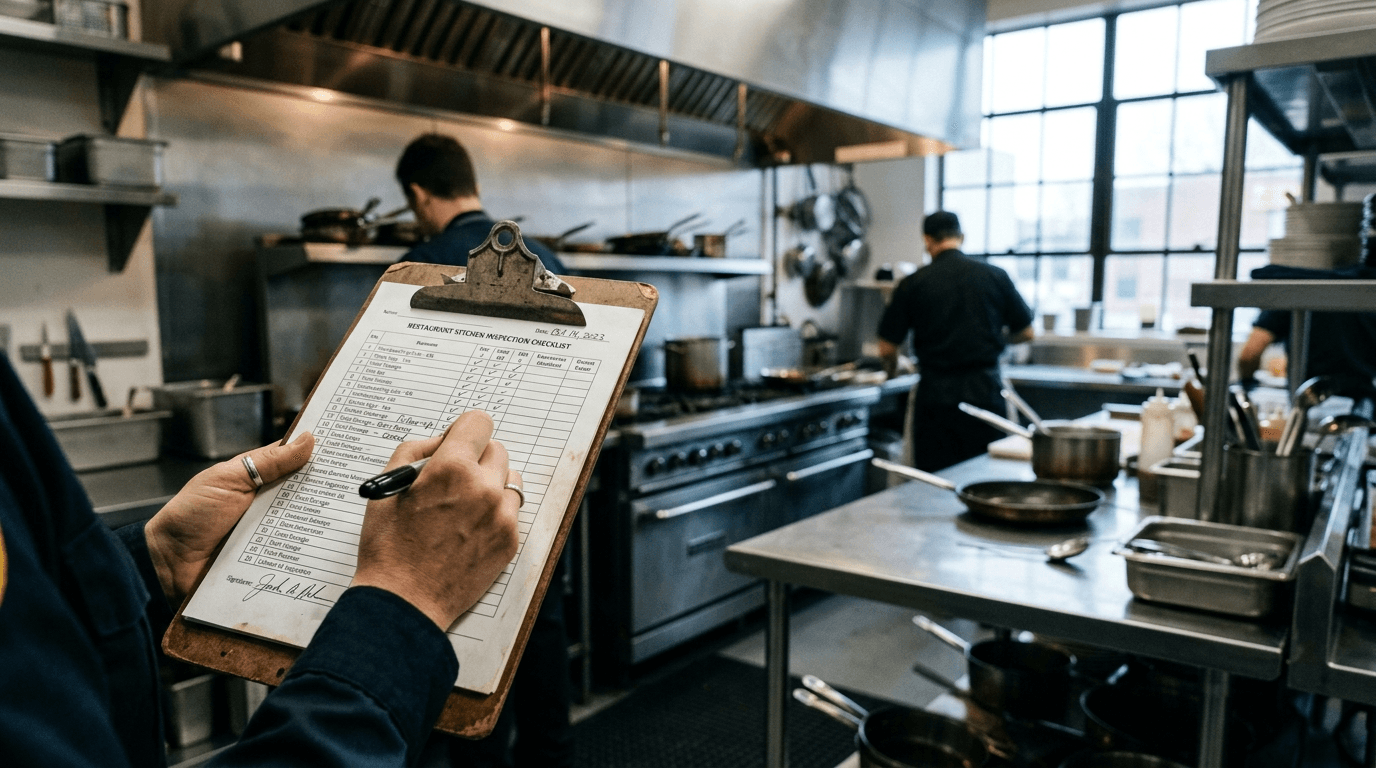
What does the inspector actually check?
A lot of operators picture an inspection as a hunt for grease on the extraction hood. That view is dated. A 2026 inspection is first and foremost a documentary and systemic check — does your organisation guarantee food safety day to day, not just on the day someone happened to clean up.
The inspector looks at two things in parallel:
1. The physical state of the premises. Cold storage temperatures, use-by date labelling, separation of clean/dirty flows, condition of food contact surfaces, delivery traceability. The visible side.
2. The robustness of your documentation system. Your FSMS, the last 15 days of temperature logs, recipe cards with allergens at inspection, the signed cleaning schedule, proof of team training. The invisible side — and where most places get pulled up.
What generates the most non-conformities
| Check point | Frequency in reports | Ease to fix |
|---|---|---|
| Missing or expired use-by dates | Very high (~20% of reports) | Easy — daily process |
| Incomplete temperature records | High | Easy — automatable |
| FSMS missing or outdated | High | Medium — foundational work |
| Team training not documented | Medium | Medium — traceability |
| Clean/dirty flow separation | Medium | Sometimes structural |
| Allergens not displayed | Medium | Easy — menu update |
| Out-of-spec temperatures | Variable | Equipment urgency |
The good news: the first 4 lines you can fix without a penny of equipment investment.
How do you prepare for a restaurant food safety inspection?
You don't know when they're coming. That's where most people get stuck. But "no notice" doesn't mean "no preparation". It means your system has to be in permanent shape, not in panic-the-night-before shape.
The steps in the right order:
-
Get your FSMS current and accessible. Not in a drawer, not in a shared folder nobody knows about. It has to be presentable in under 3 minutes. To build an FSMS ready for inspection, templates exist that fit independents.
-
Automate temperature recording. The last 15 days have to be traceable. Connected probe, app, daily signed paper sheet — doesn't matter how, as long as it's done and dated.
-
Sweep your use-by dates top to bottom. Not just the display. Cold prep, day's preparations, opened products. 20% of reports flag this — the most absurd one to get because it's the simplest to avoid.
-
Document team training. Food safety certificate, internal training sheet, sign-in sheet for in-house briefings — something has to prove the team knows the basics.
-
Check allergen display. Menu, board, or register available on request. The legal obligation has been clear since 2014 (EU Reg 1169/2011, retained in UK law). For updated legal obligations, check your menu is compliant.
-
Keep your recall list current. If a product you use is recalled, you have to remove it and prove it. Regularly checking product recalls is part of your HACCP system.
Run a "fake inspection" every quarter. Get someone who isn't in the kitchen to come ask for your FSMS and your records. If they can't find them in 5 minutes, the inspector won't either.
Case study — La Verrerie, surprise inspection 2017
In 2017 I was deep in the turnaround at La Verrerie in Gaillac. Hotel-restaurant, 14 rooms, lunch and dinner service. The Tarn DDPP inspector arrived on a Tuesday at 10am, no notice, while the chef was prepping service.
The inspection ran 2 hours. She started with cold storage — temperatures, labelling, flow separation. Then she asked for the FSMS. I produced it in under 3 minutes: structured folder, current records, signed cleaning schedule. She noted 4 minor non-conformities — two badly labelled use-by dates on day's preparations, a fridge probe drifting slightly, and an unsigned cleaning sheet for the previous week.
Result: report with 4 observations, no improvement notice, no closure. A follow-up letter 3 months later to verify the corrections.
What changed everything was the FSMS being presentable. The inspector said it herself: "You have the system, just a few adjustments needed." That's exactly it. A restaurant without a system, even spotless that day, is a risk taken. A restaurant with a visible, coherent system, even imperfect on two or three minor points, is a credible base.
Inspection result: how it actually plays out
The inspector takes notes throughout the visit. At the end, they write up a report. In the UK the Food Hygiene Rating Scheme publishes a 0-5 rating publicly online (food.gov.uk). In France Alim'confiance (mandatory since 2017) publishes a rating in 4 levels.
| UK Food Hygiene Rating | What it means | What happens next |
|---|---|---|
| 5 — Very good | Zero or very minor non-conformities | Nothing. Next visit in 3-5 years |
| 4 — Good / 3 — Generally satisfactory | Minor non-conformities | Follow-up letter, corrections expected |
| 2 — Improvement necessary | Significant non-conformities | Improvement notice, deadline imposed |
| 1 — Major improvement / 0 — Urgent | Major non-conformities or risk | Possible emergency prohibition / closure |
A "1" or "0" rating triggers a follow-up visit, this time announced.
Common mistakes before an inspection
Not updating your FSMS for 6 months is the most common mistake — and the one the inspector spots in 30 seconds. An FSMS dating from opening with no revisions, it shows. To avoid that, mastering HACCP before the inspection is the indispensable starting point.
- Confusing visible cleanliness with documentary compliance. Your kitchen can shine; if you don't have 15 days of temperature logs, you have a problem.
- Keeping a generic FSMS template downloaded off the internet. The inspector recognises non-adapted templates instantly. What counts is that your FSMS describes your restaurant, your processes, your team.
- Storing the documents somewhere unreachable during service. If you spend 20 minutes hunting for the HACCP folder in front of the inspector, you walk away with a negative comment even if the document itself is fine.
- Skipping training records. A competent but undocumented team doesn't count. There has to be a trace.
- Neglecting allergens on new dishes. Change the menu, update the allergens at inspection in the same move — not 3 weeks later.
Conclusion
An inspection isn't a surprise exam you cram for the night before. It's a check that your system runs in real time, not just on the day. Three things to take away:
1. The FSMS is your best ally. Not a folder for show — a living document, current, presentable in under 5 minutes.
2. The most frequent non-conformities are the most avoidable. Wrongly labelled use-by dates, missing temperature logs, allergens out of date: those are daily processes, not investments.
3. The inspector isn't the enemy. They want to know whether you control food safety in your business. If you have the system, even imperfect on a few points, you walk away with correctable observations — not a closure.
A real project gets built, not dreamed up. Inspection day proves which of the two yours is.
Si t'as aimé cet article, lis celui-ci ensuite :
→ Restaurant FSMS: your Food Safety Management System in 2026 (template + software)↗Articles liés
Restaurant FSMS: your Food Safety Management System in 2026 (template + software)
Food Safety Management System: required content, downloadable template, the method to keep it current without giving up your evenings.
HACCP for restaurants: the complete 2026 guide (method + FSMS + software)
HACCP: principles, the 7-step method, food safety management system, temperatures, traceability. Pass an EHO/FSA inspection without sweating in 2026.
HACCP temperatures restaurant 2026: the standards (+ logs)
HACCP temperatures restaurant: 2026 standards, cold/hot thresholds, log frequency, penalties. Field-tested method.
Restaurant legal obligations 2026: the complete guide (hygiene + FIC + tax)
Restaurant legal obligations 2026: HACCP, allergens, price display, receipts, HMRC, VAT. Compliance checklist.
Last updated 2026. Written by Cyril Quesnel, founder of Onrush, ex-cook (La Verrerie 2015-2018, Lunch Wagon 2023-2026).