Best restaurant software 2026: the complete comparison (top 10)
2026 comparison of restaurant management software: food cost, recipe cards, HACCP, stock, ordering. Selection criteria + comparison table.
In short. There is no single best restaurant software — there is the one that fits your size, your operation and your level of pressure on the floor. This 2026 comparison goes through the 7 criteria that actually matter when you are in the kitchen, with real pricing (£25 to £220/month) and a clear decision grid for an independent operator or a group.
Context / Definition
In 2026, the restaurant software market is saturated. Between POS systems, food safety tools, food cost SaaS and all-in-one platforms, it is hard to know what you actually need. Most comparisons are written by people who have never run a service. This one is written by someone who turned around two failing businesses and tested 4 different tools while still on the pass.
Restaurant management software: a digital tool that centralises one or more operational flows — food cost, recipe cards, food safety, supplier ordering, stock, rotas or POS — to replace spreadsheets, paper binders and Post-it notes.
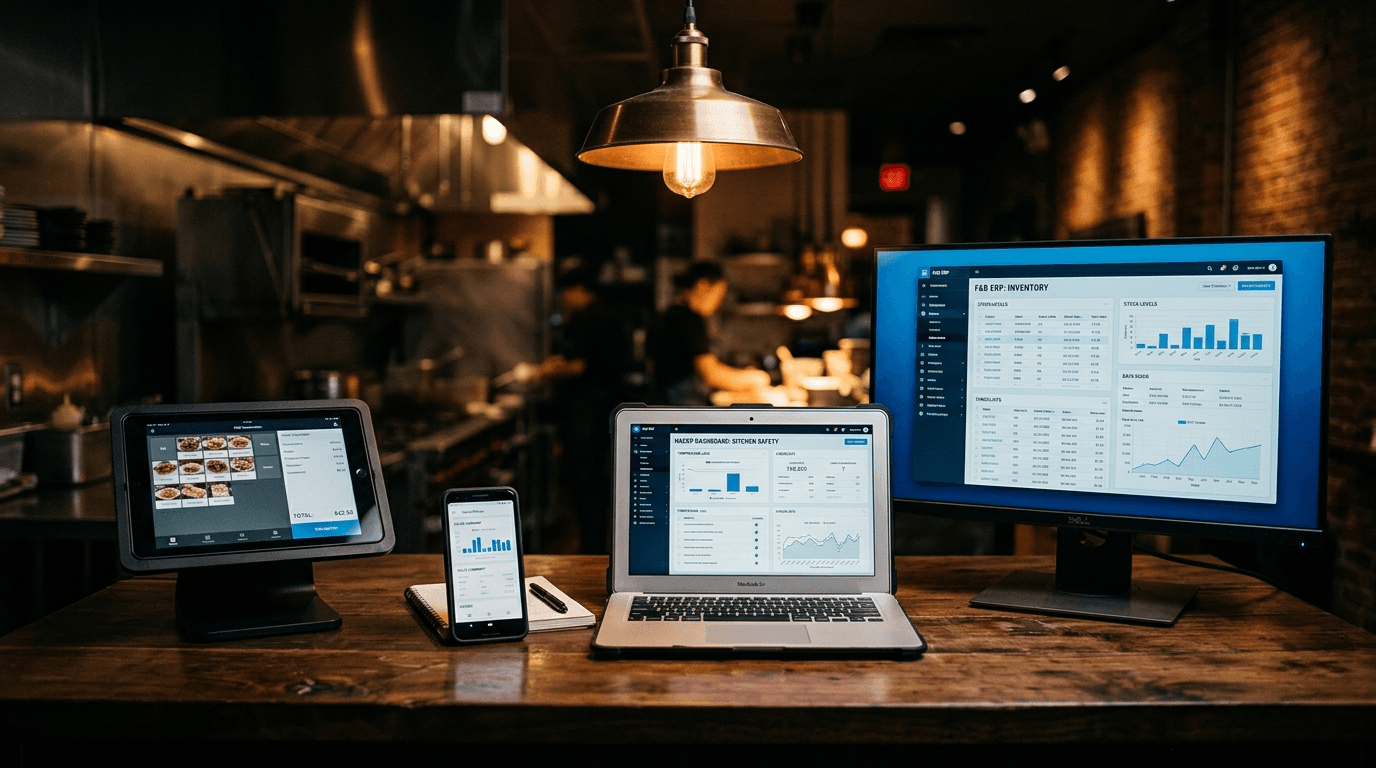
What are the 7 criteria that actually matter?
Most operators choose software on two criteria: price and what the rep showed them in the demo. That is exactly the mistake. Here are the 7 criteria that decide whether you will still be using the tool in 6 months.
1. Real-time food cost
The annual P&L is too late. What you want is to know today whether your margin on the daily special is at 28% or 42%. A dedicated food cost software must recalculate automatically when a supplier price changes — not next week, now.
Good question to ask in a demo: "If my cheese supplier puts prices up 8% tomorrow, how many recipe cards are recalculated, and how fast?"
2. Mobile food safety logging
An EHO inspection does not call ahead. The inspector turns up on a Monday at 9:30, you are on the pass, your sous chef is finishing a delivery. A dedicated HACCP software must work on a phone, allow a check in 30 seconds and produce an exportable report on the spot. If it is desktop only, it is dead.
3. Supplier ordering
Building an order by hand takes 40 minutes. Software that cross-references your sales, your stock and your reorder points can bring that down to 5. Look for an ordering tool that pulls directly from your supplier price list.
4. POS integration
Your back-office needs to pull real sales data to calculate a reliable food cost. If it does not talk to your POS (Toast, Square for Restaurants, Lightspeed Restaurant, SumUp), you will end up re-entering everything by hand. That does not last.
5. A mobile app that actually works during service
This criterion eliminates 60% of the market. An interface designed for a 15-inch screen does not work when your hands are in the flour. The tool must be mobile-first, not mobile-compatible. Big difference.
6. Learning curve
Between 1 and 8 weeks depending on the tool — that is the real spread observed in 2026. A chef plating 60 covers a night does not have 8 weeks to give to software training. If the basics take more than 2 days to land, that is a red flag.
7. Price-to-profile fit
A tool built for a group finance department is not adapted to an independent chef running solo. You can pay £200/month for features you will never use 80% of. The right restaurant software is the one calibrated for your profile — not the most feature-complete on paper.
How to choose by size and configuration?
No universal answer. The right question: how many sites, what team, what budget?
- Top priority
- Real-time food cost + mobile food safety
- Monthly budget
- £25 to £75/month
- Complexity tolerance
- Low — no IT team
- Tool type
- Mobile-first chef back-office
- Top priority
- Consolidation + shared recipe cards
- Monthly budget
- £75 to £130/month
- Complexity tolerance
- Medium — dedicated manager
- Tool type
- Back-office with multi-site
- Top priority
- HR + accounting + POS integration
- Monthly budget
- £130 to £220/month
- Complexity tolerance
- High — head office team
- Tool type
- Full ERP or integrated stack
Before you buy anything, spend a week noting the 3 tasks that cost you the most time and energy in your day-to-day. The right software solves those 3. Not the other 47.
Case study — 4 tools tested at La Verrerie in 2 years
When I took over La Verrerie in Gaillac in administration (2015-2018) — bistronomie hotel-restaurant, 14 rooms, spa — I tested 4 different tools. Only one stuck.
Tool #1 — Desktop only
Clean interface, readable dashboard on the office screen. But to log a temperature reading, you had to open the laptop, wait for it to load, log in. Mid-service, impossible.
Verdict: dropped after 3 months. The tool was never where I needed it.
Tool #2 — The overkill ERP
Sold by a very persuasive rep. Too many features. Onboarding took 6 weeks. 6 weeks trying to understand nested menus, while I was managing an administration.
Verdict: abandoned. Wrong moment to learn an ERP.
Tool #3 — No POS integration
No connection with my POS. I was re-entering sales by hand every night. Two weeks in, I had stopped.
Verdict: what is the point of a food cost calculated on sales data that is 3 weeks old?
Tool #4 — The only one that stuck
The only one that worked properly on a phone during service. Learning curve: 4 days. Used every day until the resale.
Verdict: one boring criterion (mobile-first) eliminated the other three.
The lesson: the best restaurant software is the one you actually use. Not the one with the longest feature list in the brochure.
Comparison of tool families available in 2026
This comparison does not name names — it maps the categories of tools so you know where to look depending on your need.
- Focus
- Payments, tickets
- 2026 price
- £25 to £75/month
- Mobile-first
- Variable
- Real-time food cost
- No
- Learning curve
- 1 to 2 weeks
- Focus
- Food cost, recipe cards, ordering
- 2026 price
- £25 to £75/month
- Mobile-first
- Often yes
- Real-time food cost
- Yes (price cascade)
- Learning curve
- 2 to 4 days
- Focus
- Traceability, temperatures, HACCP
- 2026 price
- £25 to £55/month
- Mobile-first
- Often yes
- Real-time food cost
- No
- Learning curve
- 1 to 3 days
- Focus
- HR, accounting, POS, stock
- 2026 price
- £130 to £220/month
- Mobile-first
- Rarely
- Real-time food cost
- Variable
- Learning curve
- 4 to 8 weeks
What this comparison says clearly: a POS and a chef back-office are complementary — they do different jobs. Many operators think their POS steers their margins. It takes payments. Not the same thing.
Common mistakes when choosing restaurant software
Picking a tool "because the place down the road uses it" — without checking whether your profiles and needs match. A food truck and an 80-cover gastropub do not have the same priorities.
Mistake 1 — Buying the most feature-complete software rather than the one that fits. More features = more complexity = less actual use. If you only use 20% of a £180/month tool, you are paying £144 a month for nothing.
Mistake 2 — Not testing on mobile before signing. Always ask for a demo on your own phone, in real conditions. Not on the rep's MacBook in a well-lit meeting room.
Mistake 3 — Underestimating the learning curve. Between 1 and 8 weeks depending on the tool — that is the real spread. Ask: "How long until my team is autonomous on the essentials?" If the answer is vague, bad sign.
Mistake 4 — Ignoring POS integration. A food cost tool that does not pull your sales automatically is useless. You will end up re-entering. And you will not keep doing it long.
Mistake 5 — Confusing POS with management software. Your POS takes payments. It does not calculate margin on your daily special. For that, you need a recipe card tool paired with a food cost module.
Mistake 6 — Not checking food safety compliance. Your HACCP module must produce exportable, time-stamped documents accepted by your local EHO. Some tools generate logs that do not align with FSA expectations. Check before you sign.
Conclusion
Three points to take away from this comparison.
First: the best restaurant software is not the most feature-complete — it is the one your team actually uses every day. An interface that is too complex gets abandoned within 3 weeks.
Second: the 7 decisive criteria are real-time food cost, mobile food safety, automated supplier ordering, POS integration, a real mobile app, a short learning curve and a price-to-profile fit. Score each tool on those 7 axes — not on the brochure feature list.
Third: your POS takes payments. It does not steer your margins. If you want to see your food cost today — not at year-end — you need a dedicated back-office. Those two tools are complementary, not competing.
20 minutes pour voir ce que ça change sur ton restaurant
Démo guidée par Cyril. Sans engagement. Si tu es dans les 50 premiers : tarif fondateur à 49€/mois à vie.
Articles liés
Best HACCP software 2026: comparison + criteria (top 5)
2026 comparison of restaurant HACCP software: temperature logs, food safety management, mobile, EHO alerts. Top 5 reviewed.
Best food cost software 2026: comparison + selection criteria
2026 comparison of restaurant food cost software: price cascade, theoretical/actual, POS integrations. Top 5 reviewed.
Restaurant profitability: the complete 2026 guide (ratios, KPIs, daily control)
Restaurant profitability: target ratios, food cost + labour, break-even, daily KPIs. Field-tested method across 2 venues.
Restaurant stock management: complete guide 2026 (FIFO, stocktake, food waste)
Stock management: FIFO/FEFO method, stocktake frequency, costing, food waste. Software vs spreadsheet.
Last updated 2026. Written by Cyril Quesnel, founder of Onrush, chef-turned-founder — La Verrerie in Gaillac (turnaround 2015-2018, sold), Lunch Wagon in Albi (turnaround 2023-2026, sold for £52K in 3 months).