Best food cost software 2026: comparison + selection criteria
2026 comparison of restaurant food cost software: price cascade, theoretical/actual, POS integrations. Top 5 reviewed.
In short. Food cost software has one job: tell you, every day, whether you are making money or losing it. Most market tools calculate a theoretical food cost — and stop there. In 2026, real food cost software does automatic price cascade, integrates with your POS and calculates actual cost. Here are the 4 criteria to choose without getting it wrong.
Context / Definition
Food cost software has become a category of its own in restaurant management tools. But under that label, you find very different products: modules built into a POS, recipe card tools with margin calculation, full ERPs, and mobile-first PWAs designed for the chef in a hurry. They do not do the same thing. They do not give you the same visibility.
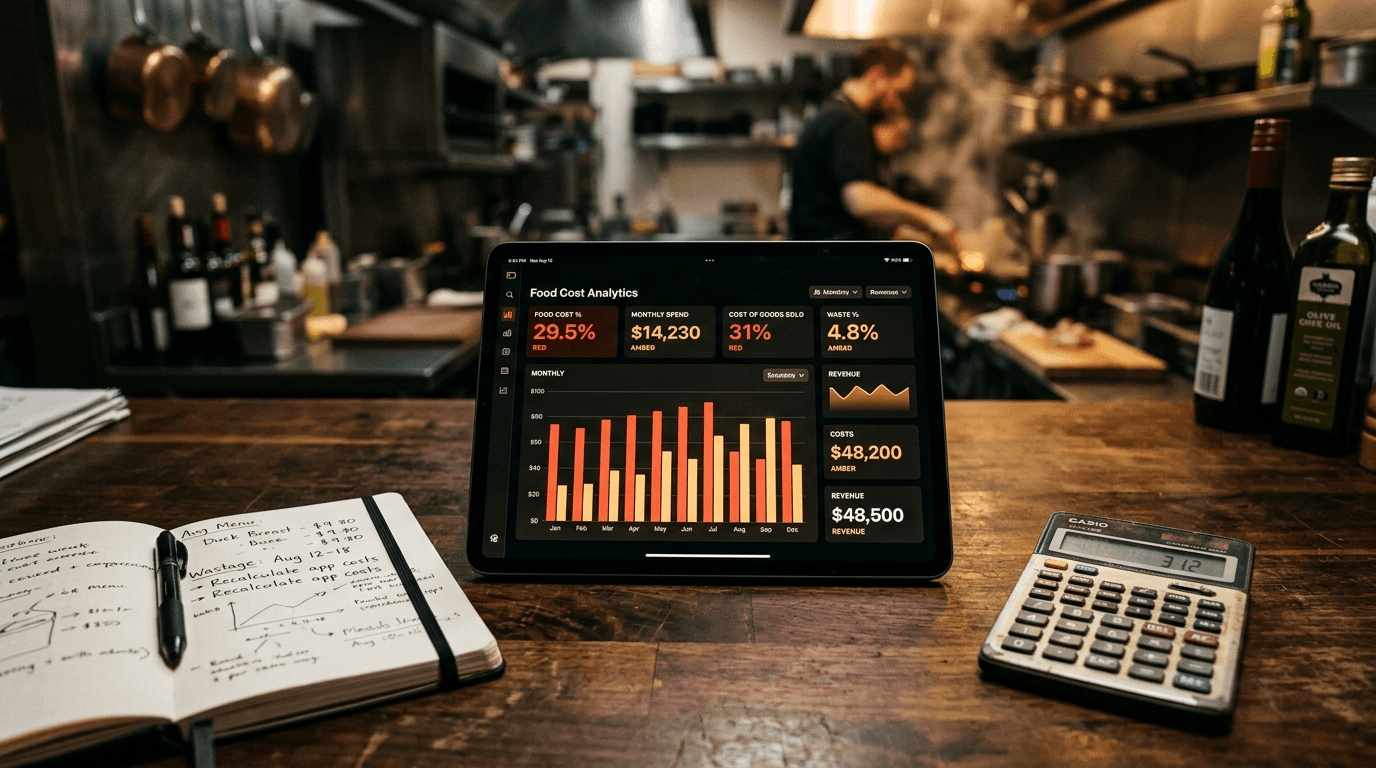
Food cost software: a tool that continuously calculates the cost-of-goods-to-revenue ratio, factoring in actual purchase prices and units sold — not just theoretical prices entered by hand.
What are the 4 decisive criteria?
Food cost software that earns its price does exactly 4 things. If one is missing, you have a spreadsheet with a subscription on top.
Criterion 1 — Automatic price cascade. When the price of your double cream goes from £2.80 to £3.40, every recipe card that uses it must recalculate in real time. Without that, you stay on stale margins until you notice — that is, too late. A well-configured price cascade earns you 2 to 4 food cost points just by removing data lag.
Criterion 2 — Actual food cost, not just theoretical. Theoretical is what you should consume according to your recipe cards. Actual is what you actually purchased divided by what you actually sold. The gap between the two is your waste, your overage, your unbilled extras, your shrinkage. A tool that only calculates theoretical gives you the illusion of pilot.
Criterion 3 — POS integration. When your food cost software is plugged into your POS, it knows your sales in real time. So it can calculate food cost on day zero, not on day 30 when you do a stocktake. Compatible POS in the UK include Toast, Square for Restaurants, Lightspeed Restaurant.
Criterion 4 — Mobile capture and ease of update. A tool you do not use because it is too heavy is worth zero. In a kitchen, you do not have 45 minutes in front of a desktop. Invoice photo capture (OCR), creating a recipe card from your phone, updating prices in 30 seconds — that is what decides whether the tool will live or die in your day.
Before comparing prices, test the cascade. Ask for a demo and change the price of an ingredient used in 10 recipe cards. If all 10 recalculate instantly, you are looking at the right tool. If not, move on.
How do these tools actually work?
The workflow of effective food cost software in 2026 looks like this:
- Supplier invoice import — via OCR (photo) or direct EDI. Items are recognised, prices updated in your supplier list.
- Auto-update of recipe cards — every recipe using an ingredient whose price changed is recalculated without action from you.
- Sales sync — through POS integration, units sold feed the actual food cost calculation as service runs.
- Daily dashboard — you see your food cost for the day, the week, the month. And you see the theoretical-vs-actual gap to spot anomalies.
- Threshold alert — if your food cost exceeds the bar you set (say 32%), you get a notification. You no longer wait for a month-end report.
This workflow has existed on paper for 20 years. The difference is that in 2026, it runs in a few minutes a day — not half a day a week.
Case study — La Verrerie, 2016
When I took over La Verrerie in Gaillac in 2015, I was looking for a tool to pilot my costs. I tested a first food cost tool in 2016. The interface was clean. The demo was convincing. Recipe cards were easy to build.
The problem: that tool only calculated theoretical food cost.
For 18 months, I had a beautiful dashboard with reassuring numbers. What I could not see: the gap between what I should have consumed and what I actually consumed. I would discover my real margins once a month, by hand, on Excel, comparing actual purchases to actual sales. Either I gave it a full evening, or I did not do it at all.
In practice, I did not do it at all. I was blind 80% of the time.
La Verrerie went from £260K to £870K in revenue in 3 years. But I could have moved faster if I had known, week after week, where my margin was actually leaking. Some months, I would have changed a supplier, dropped a dish, adjusted a portion. I only did it when crises hit, not in prevention.
That is exactly why Onrush calculates actual food cost in real time — not just theoretical.
Comparison — food cost tools available in 2026
| Criterion | Excel/Sheets | Entry-level food cost tool | Full food cost tool (e.g. Onrush) |
|---|---|---|---|
| Auto price cascade | No | Partial | Full |
| Actual food cost | Manual | Limited | Continuous |
| POS integration | No | Partner-dependent | Yes |
| Mobile / OCR input | No | Sometimes | Yes |
| Bundled HACCP | No | No | Yes |
| Monthly price (1 site) | £0 (time cost) | £25-45/month | £39-65/month |
| Multi-site | No | No | Yes |
For the overall restaurant software comparison, which also covers POS, reservations and HR, you will find a wider view of the ecosystem.
Common mistakes
Confusing recipe card software with food cost software. A recipe card calculates the margin on a dish at one moment in time. Food cost software tracks how that margin moves over time, against actual purchase prices. Different tools — even though both can live in the same app.
- Picking a tool without testing the cascade. That is the feature that makes the whole difference. If the vendor cannot show it in a demo in 5 minutes, it is not really there.
- Focusing on theoretical food cost only. Theoretical reassures. Actual pilots. If your tool only calculates theoretical, you are flying blind half the time.
- Underestimating onboarding cost. Loading 150 recipe cards into a new tool takes time. Some tools offer assisted migration. Ask before signing.
- Skipping POS integration with your current POS. Check compatibility before you buy. A loose POS integration = a loose actual food cost.
Conclusion
Three points to keep.
First, food cost software is judged on 4 criteria: automatic price cascade, actual food cost (not just theoretical), POS integration, simple mobile capture. If one is missing, the tool will not give you the visibility you need.
Second, actual food cost changes everything. Theoretical reassures you. Actual pilots you. I lost 18 months working with a tool that only calculated theoretical. That is 18 months of blind spots on my margins.
Third, the tool is worth nothing if you do not use it. Ease of use — invoice OCR, recipe card from your phone — decides whether you open it every day or let it sleep. Test the ergonomics before the pricing.
20 minutes pour voir ce que ça change sur ton restaurant
Démo guidée par Cyril. Sans engagement. Si tu es dans les 50 premiers : tarif fondateur à 49€/mois à vie.
Articles liés
Best restaurant software 2026: the complete comparison (top 10)
2026 comparison of restaurant management software: food cost, recipe cards, HACCP, stock, ordering. Selection criteria + comparison table.
Best HACCP software 2026: comparison + criteria (top 5)
2026 comparison of restaurant HACCP software: temperature logs, food safety management, mobile, EHO alerts. Top 5 reviewed.
Restaurant profitability: the complete 2026 guide (ratios, KPIs, daily control)
Restaurant profitability: target ratios, food cost + labour, break-even, daily KPIs. Field-tested method across 2 venues.
Recipe card restaurant: the complete 2026 guide (template + software)
Recipe card: structure, allergens, plate cost, gram weights, automatic updates. Free template + field-tested method.
Last updated 2026. Written by Cyril Quesnel, founder of Onrush, chef-turned-founder (La Verrerie 2015-2018, Lunch Wagon 2023-2026).