Allergens in restaurants: 2026 obligations (FIC + 14 allergens)
The 14 allergens you must declare, display formats, penalties. A method so nothing slips through the kitchen.
TL;DR. EU FIC Regulation 1169/2011 (UK retained) requires operators to declare 14 mandatory allergens on every dish — menu, recipe card and verbal staff response. Miss or error: fines per offence and an Environmental Health improvement notice. Here's the full list, the accepted display formats and the method to miss nothing.
Context: what EU FIC requires from restaurants
EU FIC Regulation 1169/2011 (Food Information to Consumers, retained in UK law post-Brexit) requires every catering professional — traditional restaurant, food truck, caterer, canteen — to inform the customer about the presence of 14 major allergens in every dish offered.
EU FIC Regulation (Food Information to Consumers): EU text 1169/2011, retained in UK law, that makes allergen declaration mandatory in commercial catering, both on the menu and in the kitchen via internal recipe cards.
This regulation isn't only about display on the customer side. It also engages your internal documentation. That second piece is what most operators miss — and it's exactly what got me an improvement notice at La Verrerie.
What are the 14 mandatory allergens?
Here's the exhaustive list set by EU FIC. These 14 catering allergens are the only ones covered by the legal obligation — but nothing stops you going further.
- Gluten (wheat, rye, barley, oats, spelt, kamut)
- Crustaceans (prawns, lobster, crab, langoustine)
- Eggs
- Fish
- Peanuts
- Soy
- Milk (including lactose)
- Tree nuts (almonds, hazelnuts, walnuts, cashews, pistachios, Brazil nuts, macadamia, Queensland nuts)
- Celery
- Mustard
- Sesame seeds
- Sulphites and sulphur dioxide (> 10 mg/kg or 10 mg/l)
- Lupin
- Molluscs (oysters, mussels, squid, snails)
Every dish must list the allergens it contains, directly or indirectly via a sauce, a stock, a marinade. If you use a clarified butter that contains traces of milk, milk shows up. If your vinaigrette contains mustard, mustard shows up.
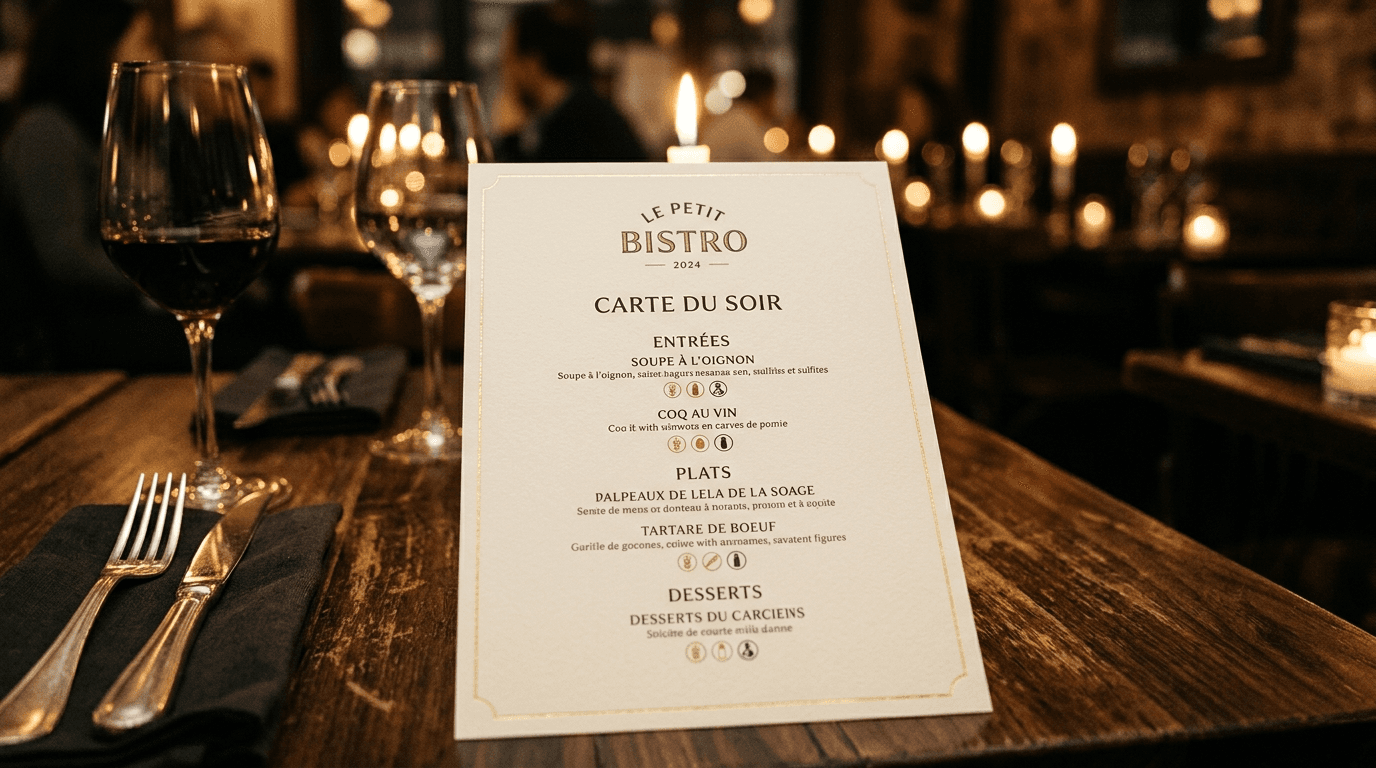
Start by drawing up an in-house list of the allergen ingredients you use most. For me at La Verrerie: gluten (bread, flour), sulphites (cooking wines), milk (butter, cream). That base mapping takes 30 minutes and saves you from 80% of misses on cards.
How to display allergens in a restaurant
EU FIC gives you three valid formats for restaurant allergen display. You can combine several — none is required on its own.
Option 1 — The menu
Direct mention on the written support handed to the customer. Two sub-options:
- Standard pictograms next to the dish name
- Text mention (e.g. "contains gluten, milk, eggs")
Option 2 — A separate consultable display
A binder, a board, a screen, a laminated card available on customer request. The menu then points to that support with the line "allergen list available on request."
Option 3 — Verbal information by staff
A trained server can answer at customer request. However: this option doesn't exempt you from up-to-date internal documentation. If the server gives a wrong answer because your card is wrong, you remain responsible.
| Format | Strength | Limit |
|---|---|---|
| Menu with pictograms | Visible, immediate, zero friction | Heavy to update on every menu change |
| Consultable binder | Easy to keep current | Customer has to ask — less visible |
| Verbal information | Flexible, fits small businesses | Requires serious staff training and reliable internal documentation |
| Digital support (QR code) | Instant updates | Requires hardware and a connection |
The combination that works best in practice: pictograms on the menu + detailed internal binder (with the recipe cards) + staff brief on every menu change.
Real case — the 2017 Environmental Health visit at La Verrerie
In 2017, an Environmental Health officer turned up at La Verrerie, Gaillac. I wasn't pre-warned — that's rarely the case.
The menu was clean. Allergen pictograms were in place customer side. I was reasonably calm. The problem came from the other side: the internal recipe cards.
Out of 22 cards checked that day, 3 had no allergens column filled in. Dishes I'd been preparing for months, that I knew by heart — but whose documentation was incomplete. To the inspector, incomplete internal documentation means you don't have the means to guarantee customer-side info.
Result: improvement notice. No immediate fine that round, but an obligation to fix and pass a follow-up inspection. The time spent redoing the cards, getting the inspector back, managing the team's stress — that's a day and a half of work I hadn't planned.
The lesson is simple: allergen obligations aren't just a customer-facing thing. They start in your internal documentation. A recipe card without allergens is, to Environmental Health, an incomplete card.
Since then, recipe cards that integrate allergens aren't optional for me — that column is as mandatory as food cost.
Penalties for non-compliance
The legal allergen obligation in restaurants isn't symbolic. The penalties are concrete:
| Offence type | Penalty |
|---|---|
| Allergen not declared on the menu | Administrative fine per offence |
| Incomplete internal documentation | Environmental Health improvement notice + follow-up inspection |
| Customer allergic reaction | Civil liability (criminal if negligence is proven) |
| Repeat offence | Aggravated penalties, possible administrative closure |
The number to remember: fines per offence. If you have 3 non-compliant cards on inspection day, that's 3 separate offences. And that's not the worst-case scenario — the worst case is a customer in anaphylactic shock because an allergen wasn't declared.
To understand how to actually prepare for an inspector visit, see the section on preparing for an Environmental Health visit.
How are you handling allergens today?
- Ingredient update
- Go back through every card
- Miss risk
- Very high — human
- Environmental Health export
- Photocopies of the binder
- Supplier change
- Nothing recalculates
- Ingredient update
- 20 to 40 cells to tick
- Miss risk
- High — copy-paste
- Environmental Health export
- Print the table
- Supplier change
- Manual
- Ingredient update
- Propagated to every card
- Miss risk
- Low — single source
- Environmental Health export
- PDF per dish in 3 clicks
- Supplier change
- Allergens auto-reassessed
Common mistakes managing allergens
Believing that allergens on the menu are enough. Environmental Health also checks your internal recipe cards. A clean menu with empty cards = guaranteed improvement notice.
- Forgetting secondary ingredients: the chef's veal stock contains celery, the in-house vinaigrette contains mustard. Those "small" ingredients often slip through.
- Not updating on every menu change: you create a new dish for the summer menu, you forget to do the recipe card with allergens before evening service.
- Training staff once: the casuals and seasonals who arrive in July don't know the allergens in your dishes. An allergens brief is part of induction.
- Confusing "trace of" and "contains": traces (possible cross-contamination) aren't legally required to declare — but mentioning them avoids serious situations.
- Using a food safety system or binder that isn't current: if your management tool doesn't tie allergens to recipe cards, you handle it manually on Excel and miss updates. A food safety system that integrates allergens centralises that automatically.
To go further on document structure: see how to build a recipe card example with allergens from the start, rather than filling it in after the fact.
Conclusion
The restaurant allergen obligations in 2026 boil down to three points:
- 14 allergens to declare on every dish — customer-side AND in your internal documentation.
- Three accepted display formats — menu, consultable support, verbal information. The menu mention isn't required, but the internal documentation is.
- Fines per offence — and civil liability the moment a customer reacts.
What I wish I'd known before the 2017 inspection: a poorly handled allergen doesn't start at the front of house, it starts on the recipe card. If you want to build a real compliant documentation base, start with the restaurateur legal obligations 2026 for the full picture.
Si t'as aimé cet article, lis celui-ci ensuite :
→ Recipe card restaurant: the complete 2026 guide (template + software)↗Articles liés
Recipe card restaurant: the complete 2026 guide (template + software)
Recipe card: structure, allergens, plate cost, gram weights, automatic updates. Free template + field-tested method.
Recipe card restaurant: a real-world downloadable example (2026)
A complete recipe card example: Beef Tartare — gram weights, cost, allergens, margin. Free downloadable template.
Restaurant FSMS: your Food Safety Management System in 2026 (template + software)
Food Safety Management System: required content, downloadable template, the method to keep it current without giving up your evenings.
Restaurant legal obligations 2026: the complete guide (hygiene + FIC + tax)
Restaurant legal obligations 2026: HACCP, allergens, price display, receipts, HMRC, VAT. Compliance checklist.
Last updated 2026. Written by Cyril Quesnel, founder of Onrush, restaurateur (La Verrerie 2015-2018, Lunch Wagon 2023-2026).