
Restaurant Recipe Card Example US: Real Template + Food Cost
A complete US restaurant recipe card example: Smash Burger — oz/lb weights, food cost in $, FDA 9 allergens, gross margin. Free downloadable template.
The short version. A restaurant recipe card is one card per dish with US weights (oz/lb), food cost per portion in $, FDA 9 allergens, and your margin. On the Smash Burger example below: $3.85 food cost per portion, $14.00 net menu price, 27.5% food cost, $10.15 gross margin. Every line is broken down here, with a free downloadable template at the end.
What a recipe card actually looks like — the basics
A well-built recipe card fits on one page. Not two. The goal is an operational reference any BOH team member can read in 30 seconds, not a document that requires a culinary degree to interpret. To understand why recipe cards matter at a deeper level, the full guide covers the method. Here, we go straight to a real example.
Restaurant recipe card: one document per dish listing ingredients with US weights (oz/lb/fl oz), calculated food cost per portion in $, FDA 9 allergens, and gross margin — updated every time a vendor price changes.
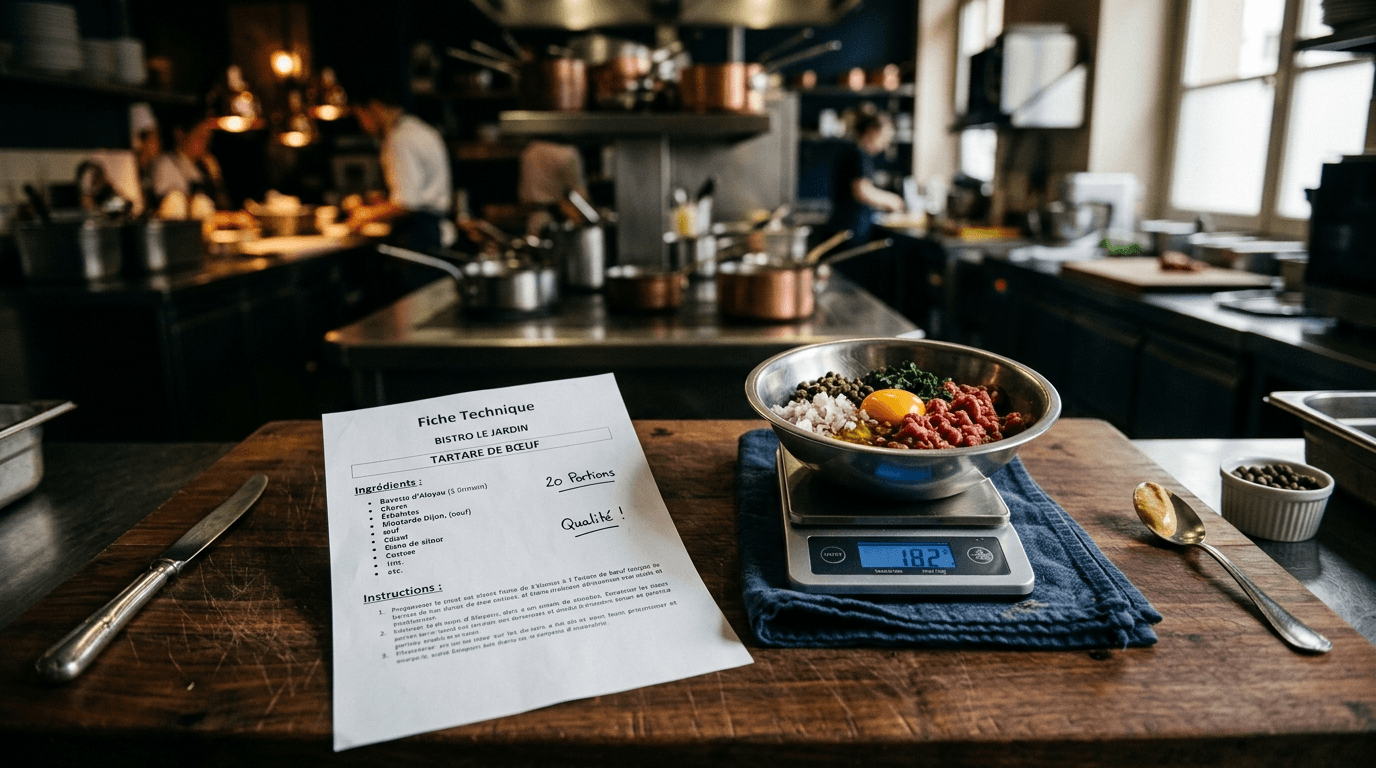
What the card contains — line by line
The header
- Dish name: Smash Burger
- Category: Entrée
- Batch size: 1 portion (always cost per portion, never per batch of 10)
- Created / Last updated: Important for allergen traceability
- Station: BOH — grill
The ingredient table
This is the heart of the card. Every ingredient gets:
- Exact name (ground beef 80/20, not just "beef")
- Net weight in US units — oz, lb, or fl oz — after any trim or breakdown
- Unit cost — from your current vendor price list (cost per oz or per fl oz)
- Cost for this portion — net weight × unit cost
The allergen block
Legally required under FDA Food Code §3-603.11. The 9 major allergens must be identified for every dish. Missing one during a health inspection is a potential finding.
The cost and margin block
- Total food cost per portion ($ sum of all ingredients)
- Net menu price (ex-tax)
- Food cost % = food cost ÷ menu price × 100
- Gross margin = menu price − food cost
This block tells you whether the dish is financially viable. For the full costing method in US units, a dedicated guide walks through every step.
How to build the card — 7 steps
- Define the reference portion — always 1 portion, per the menu as served.
- List every ingredient — including condiments, oils, garnishes. Everything that costs money goes on the card.
- Weigh each ingredient NET — after trim, bone-out, peeling. Not gross received weight.
- Calculate yield percentage — (net ÷ gross) × 100. A 10 oz beef patty from 11.5 oz of ground beef = 87% yield. Factor this into your cost.
- Pull current vendor prices — from your actual invoices, not from memory or a 6-month-old list.
- Identify the 9 FDA allergens — for each ingredient, mark which allergens are present. The card consolidates the dish-level allergen list.
- Calculate margin — and decide whether the selling price is coherent with your food cost target.
Start with your 5 highest-volume dishes, not your full menu. Those 5 represent the majority of your daily food cost exposure. Get those right first. The rest can follow over the next two weeks.
Real example — Smash Burger, 2026
This is a real recipe card built for a smash burger served at a casual counter-service restaurant. Every number reflects realistic 2026 US vendor pricing from a mid-size broadliner.
| Ingrédient | Grammage | Prix | Coût |
|---|---|---|---|
| Ground beef 80/20 | 4 oz (net) | $0.29/oz | $1.16 |
| Brioche bun | 2.5 oz | $0.22/oz | $0.55 |
| American cheese (1 slice) | 0.75 oz | $0.26/oz | $0.20 |
| Shredded iceberg lettuce | 1 oz | $0.09/oz | $0.09 |
| Tomato (2 slices) | 1.5 oz | $0.08/oz | $0.12 |
| White onion (thin sliced) | 0.5 oz | $0.05/oz | $0.03 |
| Pickles (dill) | 0.5 oz | $0.06/oz | $0.03 |
| Smash sauce (house) | 1 fl oz | $0.18/fl oz | $0.18 |
| Butter (for griddle) | 0.25 oz | $0.22/oz | $0.06 |
| Salt, pepper, seasoning | PM | — | $0.04 |
| Parchment paper (1 sheet) | Supply | — | $0.02 |
Note on sesame: if your bun is a sesame seed bun, add Sesame to the allergen list (FASTER Act, January 2023). For this example, the brioche bun is sesame-free — but check your specific supplier's ingredient declaration before publishing any allergen info.
27.5% food cost on a smash burger is a solid ratio for counter-service. The dish justifies its price because the card was built knowing the exact price of every ingredient. Without a recipe card, you'd estimate "around $4" — and you'd never know whether the margin was 27% or 35%.
Additional example — Street Tacos (3-piece plate)
For variety, here's a simplified costing on a more complex dish.
| Ingredient | Net amount | Unit cost | Portion cost |
|---|---|---|---|
| Carne asada (marinated) | 4 oz net | $0.38/oz | $1.52 |
| Corn tortillas (3) | 3 × 0.75 oz | $0.04/oz | $0.09 |
| White onion (diced) | 0.5 oz | $0.05/oz | $0.03 |
| Cilantro | 0.25 oz | $0.12/oz | $0.03 |
| Salsa verde (house) | 2 fl oz | $0.14/fl oz | $0.28 |
| Lime wedge | 0.5 oz | $0.06/oz | $0.03 |
| Seasoning, oil | PM | — | $0.05 |
| Total food cost | $2.03 |
Menu price: $12.00. Food cost: $2.03 / $12.00 = 16.9%. Excellent margin on a protein-forward plate because of the corn tortilla efficiency and the controlled carne asada portioning.
Allergens present: None of the 9 FDA major allergens in this base recipe (no wheat, no dairy, no soy, no sesame). Verify your specific salsa verde and seasoning blend — some contain soy or wheat.
Recipe card formats — paper, Excel, or software?
| Criterion | Paper binder | Excel / Google Sheets | Software with cascade |
|---|---|---|---|
| Card creation time | 30-45 min | 20-30 min | 8-12 min |
| Vendor price update | Full manual redo | 5 min × every card | Invoice OCR → auto cascade |
| FDA allergens | Pencil by hand | Cell by cell | Tied to ingredient |
| Live food cost in $ | No | Only if updated | Always current |
| Health inspection PDF | Photocopies | Print the table | Instant export |
| Best for | Quick reference | Under 15 dishes | 15+ dishes, live margins |
Excel works if you actually do it. The moment your broadliner raises chicken prices and you have 30 cards to update, manual work takes half a day. With invoice OCR and auto-cascade, it's the time it takes to snap a photo of the invoice.
Common mistakes on US recipe cards
Working at gross weight rather than net weight after trim is the most common and expensive mistake. A 6 oz chicken breast received is not 6 oz after trim — typically 5 to 5.3 oz net. At 80 covers per night, that 0.7 oz gap changes your real food cost by a measurable amount.
- Forgetting the smash sauce, house dressing, or condiments. A tablespoon of house ranch at $0.12/portion × 300 covers/week is $18/week in untracked food cost. Small ingredients stack.
- Not dating your cards. A card built in 2024 with 2024 prices is wrong in 2026. Vendor prices have moved significantly. Date every card and audit at least twice a year.
- Building cards just for a health inspection, not to run the business. A recipe card isn't a compliance document. It's your margin management tool. If you only build it to show an inspector, you miss 80% of its value.
- Making the card too complex. An unreadable card won't be used by the team. One page, clear headers, fast to scan.
- Not checking sesame on buns, dressings, and Asian-inspired preparations. Since January 2023, sesame is FDA allergen #9. It shows up in sesame seed buns, tahini-based dressings, certain marinades, and sesame oil finishes. Check ingredient lists on every applicable product.
Conclusion
A restaurant recipe card is three things: a margin management tool, an allergen traceability document, and a BOH reference for consistent execution.
The Smash Burger example illustrates it concretely: $3.85 food cost, $14.00 net menu price, 27.5% food cost, $10.15 gross margin. Those numbers only exist because the card was built ingredient by ingredient, net weight by net weight, at current vendor prices.
Without a recipe card, you estimate. With an up-to-date recipe card, you run the operation.
Si cet article vous a servi, lisez celui-ci ensuite :
→ Restaurant Recipe Cards US 2026: Complete Guide + Template↗Articles liés
Restaurant Recipe Cards US 2026: Complete Guide + Template
Recipe card guide for US restaurants: structure, FDA 9 allergens, oz/lb portions, food cost in $, live price cascade. Free template + field-tested method.
FDA Allergens for US Restaurants 2026: The 9 Major Allergens
The 9 FDA major allergens (including sesame added January 2023), labeling requirements, health inspection implications, and how to document allergens in recipe cards.
Best Restaurant Management Software US 2026: Full Comparison
2026 comparison of US restaurant management software: food cost, recipe cards, food safety, scheduling. 7 criteria + decision grid for indie operators.
Best Food Safety Software for US Restaurants 2026
2026 comparison of restaurant food safety software for US indie operators: temperature logs, health inspector readiness, FDA compliance, offline mode.
Last updated May 2026. Written by Cyril Quesnel, founder of Onrush — 20 years on the line in France, two restaurant turnarounds, building food safety and food cost tools for US indie restaurants.