
Food Safety Program for Restaurants: The Practical US Guide
Build a food safety program that runs daily: California SB 476, ServSafe/CFPM, temperature logs, how to stay current without drowning in paperwork.
The short version. A food safety program is not a binder you build at opening and revisit when someone complains. It is the live documentation that proves your kitchen controls food safety risk every day. In the US, it combines your FDA Food Code-based food safety plan with staff training records, temperature logs, cleaning schedules, and allergen documentation. California adds specific obligations — SB 476 food handler cards and, for most operations, a Certified Food Protection Manager (CFPM) on staff. This guide gives you the structure to build it and, more importantly, keep it current without drowning in paperwork.
What is a food safety program — and is it the same as a food safety plan?
Short answer: the food safety plan is one piece of the food safety program.
Your food safety plan (the HACCP document — see our complete guide to the food safety plan) is the analytical core: hazard identification, Critical Control Points, critical limits, monitoring, corrective actions. It is the what and why of your food safety system.
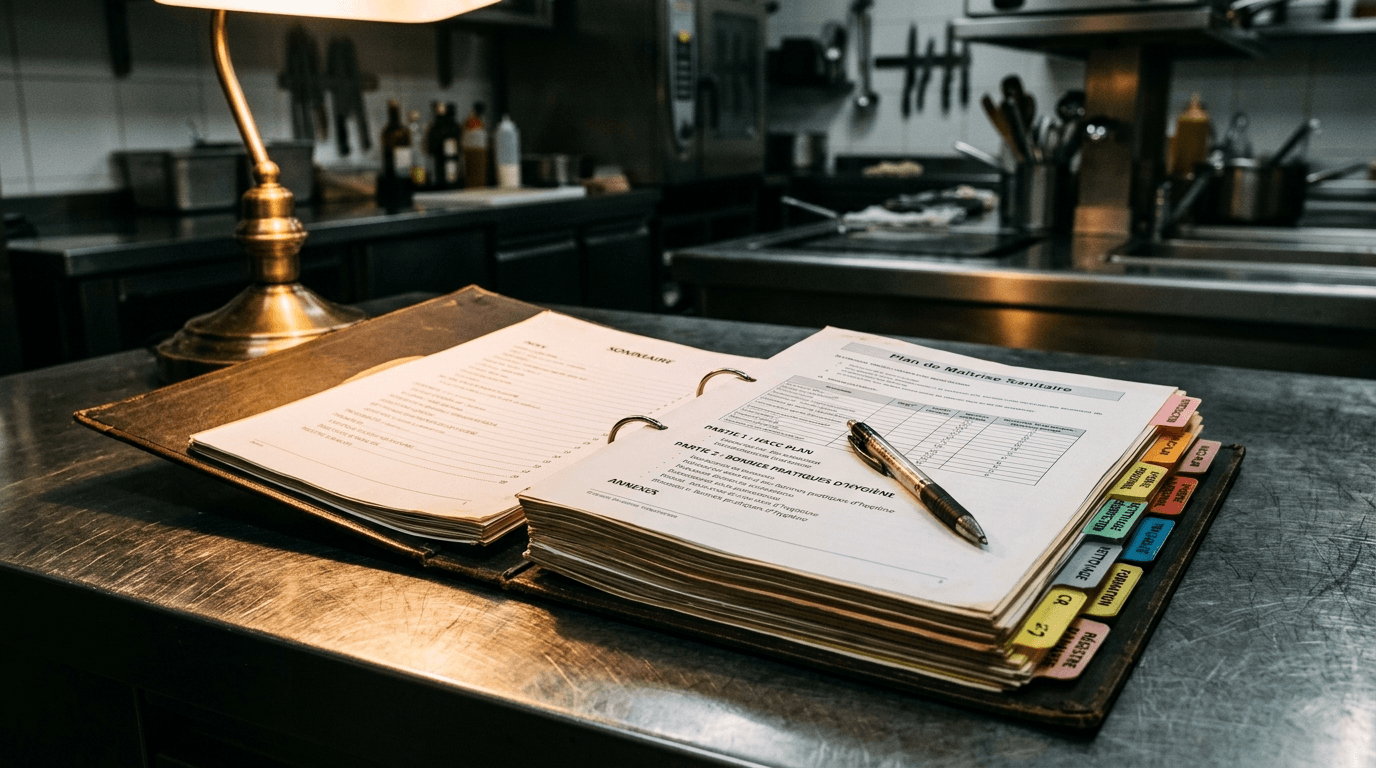
Your food safety program is the broader operational system: the food safety plan plus all the supporting documentation and daily records that prove the plan is actually running. Temperature logs, training certificates, cleaning schedules, pest control reports — all of it together.
The health inspector does not just want to see the plan. They want to see it living.
Restaurant food safety program: the complete documentation and daily record system that proves your operation controls food safety risk under FDA Food Code 2022 — not just on paper, but in daily practice.
Is a food safety program mandatory in the US?
Yes. No exceptions.
FDA Food Code 2022 requires every food establishment to implement and maintain permanent procedures based on HACCP principles. California's CalCode (§113700-114437) is one of the most comprehensive implementations in the country. The obligation covers every commercial food service operation — food trucks, independent restaurants, ghost kitchens, catering operations.
The enforcement moment: when the health inspector walks in, they ask to see your documentation. If you cannot produce a current, applicable food safety program in under 5 minutes, you are looking at violations before they even open the walk-in.
For a full read on what the health inspector checks, see the health inspection guide for US restaurants.
The 6 sections of a complete food safety program
1. Good Hygiene Practices (GHPs)
Staff hygiene is the foundation. This section covers:
- Hand washing procedures (FDA Food Code §2-301.11-14)
- Illness reporting policy — FDA Food Code §2-201.11 requires you to exclude or restrict employees with specific symptoms (vomiting, diarrhea, jaundice, sore throat with fever, infected wounds)
- Uniform and personal cleanliness standards
- Glove use and bare-hand contact restrictions with ready-to-eat food
This section has to describe what you actually do, not a generic policy copied from the internet. Inspectors recognize boilerplate.
2. Food safety plan (HACCP)
Your Critical Control Points, critical limits (temperatures in °F, times, procedures), monitoring system, and corrective action procedures. This is the technical core — see the food safety plan guide for the full 7-principle breakdown.
For temperature quick reference:
- Cold holding: ≤41°F (§3-501.16)
- Hot holding: ≥135°F (§3-501.16)
- Cooling: 135°F → 70°F in 2 hours, then 70°F → 41°F in 4 additional hours (§3-501.14)
- Poultry: 165°F (§3-401.11)
- Ground beef: 160°F (§3-401.11)
- Whole muscle beef, fish, pork: 145°F + 15-second hold (§3-401.11)
3. Cleaning and sanitizing procedures
Cleaning schedule covering all surfaces, equipment, and frequency. Products used, approved concentrations. Traceability of who cleaned what and when — signed and dated.
Unsigned cleaning schedules are a common violation. Unsigned means unverified. The inspector does not assume it happened.
4. Water and waste management
Process water source and quality verification. Grease trap maintenance. Solid waste disposal and recycling frequency. Not the most glamorous section — but its absence is noted.
5. Staff training documentation
This is where California-specific requirements hit hardest.
California SB 476 (effective January 1, 2024): all food handlers must obtain an ANSI-accredited food handler card within 30 days of hire. Employers must:
- Pay for the training during working hours
- Not require employees to obtain the card as a condition of hiring
- Retain copies of food handler cards on file
This is a change from the previous system where many employees self-funded training. Non-compliance is a violation — and it comes up during inspection because inspectors check the records on file.
Certified Food Protection Manager (CFPM): beyond food handler cards, most California jurisdictions require at least one CFPM on staff — the Person in Charge (PIC) responsible for food safety operations. The most common certification is ServSafe Manager (National Restaurant Association Educational Foundation), ANSI-CFP accredited. Valid for 5 years, proctored exam.
Other ANSI-CFP accredited options: Prometric Food Safety Manager Examination, National Registry of Food Safety Professionals (NRFSP). The exam provider does not matter — what matters is the ANSI-CFP accreditation and current status.
What to keep in your food safety program:
- Current food handler cards for all food-handling employees (or proof of enrollment within 30 days of hire)
- CFPM certificate for your PIC, with expiration date
- Internal training records: food allergy training, new employee onboarding, any safety incidents with corrective coaching
6. Pest control
Pest control contract with a licensed operator. Inspection visit frequency. Signed reports for every visit. Corrective actions for any activity found. An active, documented pest control program is standard — pest activity is a Priority violation, and no documentation is a Priority Foundation violation.
How to keep the program current without drowning in it
This is where everyone fails. Building the program once is the easy part. Keeping it current over two years of operations — staff turnover, menu changes, equipment breaking down — that is the real challenge.
The main daily maintenance burden is temperature logs. Walk-in cooler, walk-in freezer, reach-in units, hot holding equipment — minimum twice daily (start of shift and mid-service). Done manually, that is 15-25 minutes per day. Over a year, roughly 100 hours. And when you are in the middle of a service, those 15 minutes get skipped. Then again the next day. Four weeks later, your logs have gaps — and gaps are violations.
The lasting solution: automate what can be automated. Temperature logs via connected probes or guided 10-second mobile entries. Automatic alerts when a unit drifts above threshold. Non-conformity records that log the corrective action at the same time.
Manual daily entry drops to under 5 minutes. The rest — reviewing your food safety plan, updating allergen documentation when the menu changes — you do as events happen.
Case study — two operations, same kind of inspection, different outcomes
La Verrerie, France, 2017. Hotel-restaurant in the middle of a financial turnaround. Inspector showed up on a Tuesday morning. My food safety documentation was a printed folder, half-updated for the previous four months.
That night I spent six hours reconstructing missing temperature logs, finding lost training records, verifying the cleaning schedule matched what we actually did. Six hours until 2am, before the next day's service.
The inspection went fine — I had patched it just enough to pass. But that is not a system. That is panic management.
The Lunch Wagon, France, 2024. Burger food truck, taken over in financial difficulty. Same situation — inspector showed up the day after I was told to expect one. Time spent preparing the documentation: zero. Because temperature logs, cleaning records, and training records had been logged in real time from day one. I opened the tool, showed the history, the inspector checked. Clean pass.
Same standards. Same inspection dynamic. The only difference was whether records were kept in real time or reconstructed in a panic.
Paper program vs software — what actually changes
| Criterion | Paper / binder | Software-supported program |
|---|---|---|
| Initial setup | Fast (1-2 days) | Guided (a few hours) |
| Daily maintenance | 20-30 min/day | 0-5 min/day |
| Traceability gap risk | High | Low (automated alerts) |
| Inspection prep time | 3-6 hours of scrambling | 0 hours — already current |
| Allergen updates | Manual, error-prone | Built into recipe cards |
| Temperature deviation alerts | None | Real time |
| Cost | Low (paper + time) | Monthly subscription |
The apparent cost of paper is misleading. 25 minutes a day at $18/hour labor is over $2,700/year — not counting the catch-up hours before inspections. That math changes when you run it.
Want to see what a digital food safety program looks like in a real kitchen? Book a 20-minute demo at /us/demo.
Common food safety program mistakes
Building the program "for the inspection" and not applying it daily. The inspector spots this instantly — a food safety program with perfect documentation that stops three months ago is a program that does not run. The records tell the story.
Copying a generic template without adapting it. Your food safety program has to describe your kitchen, your menu, your suppliers, your team. A generic binder downloaded from the internet describes a theoretical restaurant. Inspectors know the difference.
Not updating allergen documentation when the menu changes. Every new dish, every substituted ingredient — check the allergen matrix. The 9 FDA allergens (Milk, Eggs, Fish, Shellfish, Tree Nuts, Peanuts, Wheat, Soybeans, Sesame) must be current in your documentation.
Letting ServSafe / CFPM certifications expire. CFPM certifications are valid for 5 years. Set a calendar reminder 6 months before expiration. An expired certification for your PIC is a violation — and re-certification takes time.
Zero non-conformities in the record. An operation that has never recorded a refrigerator drifting, never had a delivery refused, never had a temperature deviation — looks suspicious. The inspector does not believe it. What they want to see is that when things went wrong, you caught it, documented it, and fixed it.
The bottom line
Three things to remember about running a food safety program in 2026:
1. It is mandatory and non-negotiable. No food safety program, or a program that has not been touched in six months, equals a violation. There is no flexibility here.
2. Content matters, but daily traceability matters more. A well-written plan that is three months out of date does not protect you. The records prove the system runs.
3. Manual does not survive long-term. Twenty-five minutes a day multiplied by 365 days is a lot of time. That time either goes into real kitchen work or into paper documentation. Software gives that time back.
I lost six hours in one night at La Verrerie reconstructing records I should have been logging for months. At the Lunch Wagon, I never thought about it — because it was automated. The difference between those two nights is the tool.
Ready to see how a digital food safety program works in practice? Book a demo at /us/demo — 20 minutes, no sales deck.
Last updated May 2026. Written by Cyril Quesnel, founder of Onrush. Sources: FDA Food Code 2022 (fda.gov/food/fda-food-code), California Retail Food Code §113700-114437, California SB 476 (Health & Safety Code §113948), ServSafe (servsafe.com).
Vous voulez voir comment Onrush gère ça dans votre restaurant ?
Démo 20 min, sans engagement. On regarde vos vrais chiffres.
Demander une démo →Frequently asked questions
Is a food safety program mandatory for US restaurants?+
What does a restaurant food safety program need to contain?+
What is California SB 476 and who does it affect?+
What is the difference between a food handler card and ServSafe Manager certification?+
How do I keep my food safety program current without it becoming a full-time job?+
Articles liés
Top 10 Health Code Violations in California Restaurants
The 10 FDA Food Code violations California inspectors cite most — what triggers each one, the violation code, and the concrete fix.
Health Inspection Restaurant: How to Pass Every Time
How a health department inspection runs, what the inspector checks, top violations, PIC requirements, and a prep checklist for US restaurants.
Food Safety Plan for US Restaurants: FDA 2022 Guide
Build a food safety plan for US health inspections: FDA Food Code 2022, 9 allergens, °F temperature requirements, cooling rules, California specifics.
Walk-In Cooler Temperature Logs: FDA 41°F Rule
FDA §3-501.16 explained: 41°F cold holding rule, TCS foods covered, logging frequency, what inspectors check, paper vs digital temperature logs.